


Essential Gear for Solo Off-Grid Travel: 2026 Review
Table of Contents
- Essential Gear for Solo Off-Grid Travel: What Actually Earns Its Place
- Solo Camping Safety Essentials: The Survival Kit That Covers the Worst Case
- Solo Overlanding Recovery Gear: Winch, Traction Boards, and Load Matching
- Emergency Communication Devices for Camping: Staying Reachable Off-Grid
- Off-Grid Travel Checklist: Shelter, Water, Cooking, and Sanitation
- Weight, Packed Volume, and Vehicle-Space Trade-Offs: Packable Gear That Saves Room
- Verdict: Building a Solo Kit That Matches Your Trip Duration and Climate
- Frequently Asked Questions
Last Updated: October 8, 2026
Essential Gear for Solo Off-Grid Travel: What Actually Earns Its Place
Emergency preparedness guidance for off-grid travel now treats a three-day water supply, a trauma-equipped medical kit, and reliable off-grid communication as the baseline for anyone traveling alone, according to TravlFi's emergency preparedness guidance for overlanding. That baseline is where an essential gear for solo off-grid travel review should start, because solo travelers carry every failure alone.
The core argument here is simple. Solo travelers do not need more gear than groups do; they need gear that fails less, because there is no second person to cover a gap.
How We Evaluated: Selection Criteria and Testing Standards
We judged every category against five criteria: durability under repeated field use, solo-specific redundancy, packable volume, weight, and how the item performs when something else has already failed. A group can split the load and share backups. A solo traveler cannot, so redundancy planning carries more weight than raw capability.
The gear we recommend here comes from our own catalog, and we are upfront about that. What we can tell you is how each piece is built, what it is designed to do, and where it fits in a solo kit.
Quick Comparison: Five Core Gear Categories
This table maps the five categories a solo kit needs most, what each one solves, and the Danielson Cove product we would pack for it.
| Category | What It Solves | Our Pick | Price |
|---|---|---|---|
| Survival and safety | Worst-case injury, fire, exposure | 14 in 1 Outdoor Emergency Survival And Safety Gear Kit | $114.99 |
| Power and communication | Dead phone, dead GPS, no check-in | Outdoor emergency charging | $21.07 |
| Shelter and sleep storage | Wet sleeping bag, soaked clothing | Down Compression Outdoor Storage Bag | $15.42 |
| Weather protection | Rain and spray on exposed gear | Camouflage Outdoor Lightweight Waterproof Bag | $20.85 |
| Mobility and load support | Fatigue, unstable terrain, joint strain | Ultralight Carbon Fiber Five-section Folding Trekking Pole | $84.16 |
Solo Camping Safety Essentials: The Survival Kit That Covers the Worst Case
Solo camping safety essentials come down to one question: if you are injured, alone, and hours from help, what do you need within arm's reach? Industry guidance for 2026 recommends a trauma-equipped medical kit and a minimum three-day water supply as non-negotiable for solo travelers, per TravlFi's overlanding preparedness guidance. A compact survival kit covers the rest of that worst case.

Pros and Cons: 14 in 1 Outdoor Emergency Survival and Safety Gear Kit
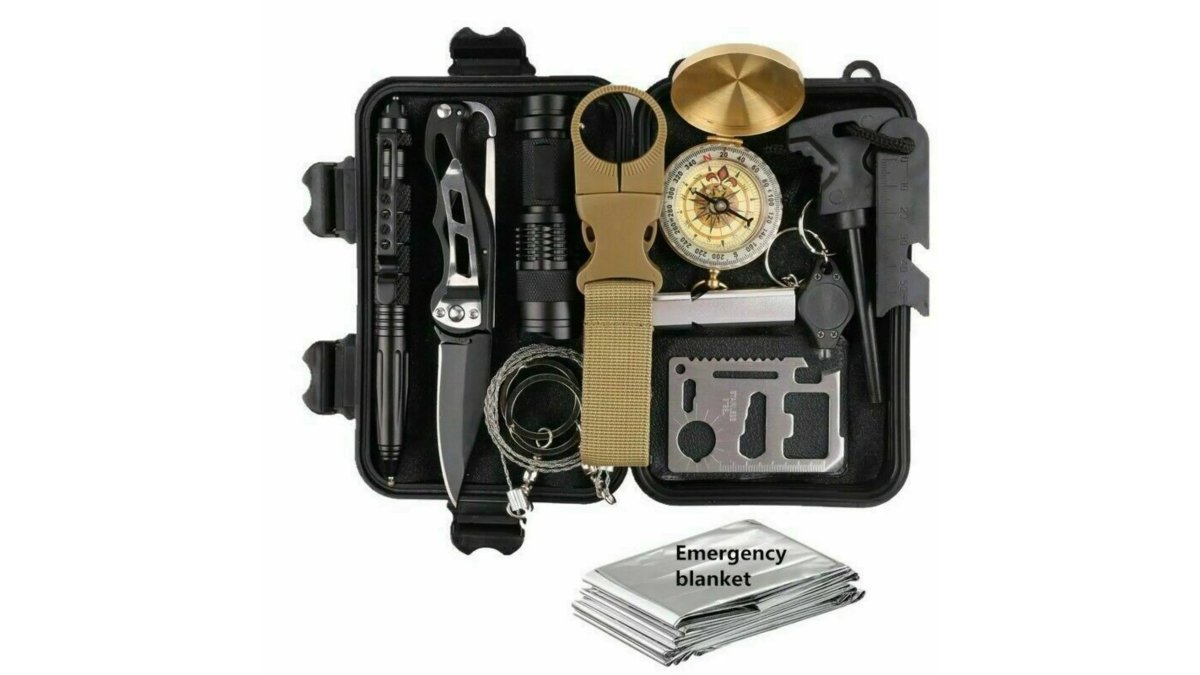
The 14 in 1 Outdoor Emergency Survival And Safety Gear Kit is our top safety pick for solo trips at $114.99.
What works: it consolidates the scattered small items that normally rattle loose in a pack into one kit you can grab in the dark.
What does not: a single kit cannot cover every scenario, so treat it as your core and add water capacity and communication separately. If you already own quality versions of several included tools, buying the kit duplicates gear you have.
Emergency Blanket, Fire-Starting Kit, and First-Aid Coverage
Three items inside a survival kit do the heaviest lifting for a solo traveler: an emergency blanket, a fire-starting kit, and first-aid coverage. The emergency blanket fights hypothermia when a wet layer or a turned ankle forces an unplanned night out. The fire-starting kit gives you warmth, light, and a signal in one action. First-aid coverage handles the cuts, blisters, and sprains that end trips early.
Solo Overlanding Recovery Gear: Winch, Traction Boards, and Load Matching
Solo overlanding recovery gear is the category where solo travelers get stuck most often, because recovery usually takes two vehicles. Industry guidance for 2026 identifies a specific mandatory set for off-grid vehicle travel: a recovery strap or kinetic rope, soft shackles, D-rings, traction boards, an air compressor, a tire repair kit, a shovel, and a winch, per Recon Recovery's overlanding gear guidance. The point of that list is not to buy all of it. It is to never need a second vehicle.
Vehicle Recovery Equipment Solo Drivers Cannot Skip
If you drive off pavement alone, four items are close to non-negotiable: traction boards, a tire repair kit, an air compressor, and a shovel. Traction boards get you out of sand, mud, and snow without a tow. A tire repair kit and compressor handle the puncture that would otherwise strand you. The shovel clears around a stuck wheel and digs out a level spot for camp.
A winch and recovery rope only help if there is something to anchor to. In open terrain, they are weight you cannot use. Match your recovery gear to the terrain you actually drive, not the terrain you imagine.
Emergency Communication Devices for Camping: Staying Reachable Off-Grid
Emergency communication devices for camping answer the question that worries every solo traveler's family: how do you call for help with no signal? A satellite messenger or personal locator beacon reaches emergency services where a phone cannot. Navigation comes second; communication comes first, because a wrong turn is survivable and a broken leg with no way to call is not.
14 in 1 Outdoor Emergency Survival And Safety Gear Kit →
Powering Your Devices: Outdoor Emergency Charging Reviewed
Every communication device is only as good as its battery. The Outdoor emergency charging power bank is our pick for keeping devices alive off-grid at $21.07. It carries USB-C and micro-USB ports for broad device compatibility, plus a standard USB-A output for older gear.

The casing is military-grade polymer with reinforced corners for impact resistance, and the compact size fits pack pockets, harnesses, or gear bags without adding bulk. One limitation worth naming: capacity is sized for top-ups, not for running a laptop or a heated device for days.
Off-Grid Travel Checklist: Shelter, Water, Cooking, and Sanitation
An off-grid travel checklist should be built around four systems: shelter and sleep, water, cooking, and sanitation. Get those four right and you can stay out for days. Get them wrong and you will cut the trip short regardless of how good the rest of your kit is. Outdoor gear reviews for 2026 group the essentials into shelter, food and hydration, safety and navigation, clothing, and specialized toiletries, per OutdoorGearLab's backpacking gear guide.
Water Storage and Purification, Food Preparation, and Insulation
Water storage and purification is the system that keeps you alive, so carry a filter or purification method plus containers for at least three days. A wet sleeping bag loses most of its warmth, so a Down Compression Outdoor Storage Bag at $15.42 protects your bag from moisture while shrinking it down.

For weather protection on exposed gear, the Camouflage Outdoor Lightweight Waterproof Bag at $20.85 uses ripstop nylon with taped seams to shed rain and spray. It comes in small, medium, and large.
Weight, Packed Volume, and Vehicle-Space Trade-Offs: Packable Gear That Saves Room
Weight and packed volume decide whether off-grid travel gear actually goes on the trip. This is the trade-off most gear guides skip: capability you leave in the garage because it would not fit is worth nothing. A solo traveler has one pack and one vehicle, so volume is a real constraint, not a preference.
The Ultralight Carbon Fiber Five-section Folding Trekking Pole at $84.16 shows how the trade-off works in practice. The high modulus carbon fiber shaft keeps weight down while staying rigid on steep descents, and the five-section design collapses to roughly 24 inches and extends to about 54 inches.
| Trade-Off | What You Gain | What You Give Up |
|---|---|---|
| Compression storage | Pack volume, dry sleeping bag | A few minutes repacking each morning |
| Five-section poles | Packed size, adjustable height | Slightly less rigidity than two-section |
| Compact power bank | Fits a pocket, light to carry | Limited capacity for heavy draws |
Verdict: Building a Solo Kit That Matches Your Trip Duration and Climate
The right solo kit is not the biggest one. It is the one matched to your trip length and climate, with redundancy built in where failure is unrecoverable. Start with safety and communication, add recovery gear for the terrain you drive, then layer shelter, water, cooking, and storage to fit the season. Packable gear that saves room gets used; gear that does not fit stays home.
That is the standard we hold at Danielson Cove. We exist to give service-oriented professionals a way to unplug and reconnect with themselves and their pets, because people who care for others deserve a place to be cared for too.
Packing for a solo trip means every item has to justify its weight, and most kits fail on the small pieces rather than the big ones. If you want gear built for that standard, start with the 14 in 1 Outdoor Emergency Survival And Safety Gear Kit, add the Outdoor emergency charging power bank for reachability, and protect your sleep system with the Down Compression Outdoor Storage Bag.
Frequently Asked Questions
What gear do you need for solo off-grid travel?
Start with five categories: safety and survival tools, vehicle recovery equipment, emergency communication, water and shelter, and power. A compact kit like the 14 in 1 Outdoor Emergency Survival and Safety Gear Kit covers tools and first-aid basics. Add a recovery strap, kinetic rope, traction boards, and an air compressor for vehicle travel. Carry a power bank for phones and GPS units, plus three days of water. Experts recommend a trauma-equipped medical kit and reliable off-grid communication as baseline requirements for solo travelers.
What are the most important safety essentials for solo camping?
Solo camping safety essentials come down to redundancy. Carry two ways to start a fire, two light sources including a headlamp, an emergency blanket, and a first-aid kit sized for the trip. A 14-in-1 survival kit bundles many of these into one packable case. Because no one is there to help, every critical system needs a backup: navigation, communication, and water purification especially. Check your gear before each trip and replace anything that failed or wore down.
How do you stay connected when traveling off-grid?
Cell service disappears fast in remote areas, so emergency communication devices for camping matter more than a strong phone signal. Satellite messengers and personal locator beacons send SOS alerts and allow two-way texting where no towers exist. Pair yours with a rugged power bank like the Outdoor Emergency Charging unit, which has USB-C, micro-USB, and USB-A ports to keep a phone and a dog's GPS tracker running. Test the device before departure and register it with the manufacturer.
What recovery gear is useful for solo overlanding?
Industry guidance for 2026 lists a specific set: a recovery strap or kinetic rope, soft shackles, D-rings, traction boards, an air compressor, a tire repair kit, a shovel, and a winch. Solo overlanding recovery gear matters most because no second vehicle can pull you out. Match every strap, shackle, and winch rating to your vehicle's load capacity, and practice using each piece in a safe area before you need it on a remote trail.
How do you choose reliable gear for off-grid travel?
Look at materials and construction first. Ripstop nylon with taped seams, 40D Silnylon, and high modulus carbon fiber all signal durability over cheap alternatives. Then check packability: a five-section trekking pole that collapses to about 24 inches and a compression bag that shrinks sleeping bags to a fraction of their size save real space. Finally, verify the gear handles repeated cleaning and weather exposure, since mud, sweat, and rain degrade weak coatings fast.