


9 Tactical Gear Picks for Backcountry Camping
Last Updated: November 4, 2026
Quick Summary
Tactical gear for backcountry camping is built for abuse rather than appearance, so it should use abrasion-resistant fabric, reinforced stitching, and a stable pack system. Look for ripstop nylon, reinforced stitching, and standardized MOLLE webbing when judging whether a product is genuinely tactical. Fit a pack to your torso length, which should measure between 16 and 22 inches.
- Measure torso length from the C7 vertebra to the top of the hip bones, not height.
- Layer a moisture-wicking base, insulation, and a waterproof shell for changing weather.
- A 500D pack with aluminum stays keeps durability while shedding weight.
- Weigh your checklist once and cut the heaviest item you did not use last trip.
- Pack navigation, light, water, and emergency gear as essentials before any optional items.
Table of Contents
- What Makes Gear Tactical in the Backcountry
- Military Backpacks for Hiking: Load Carrying and Pack Weight
- Military Tactical Clothing: Layering for Changing Weather
- Military Survival Gear: Emergency Kits, Power and Navigation
- Shelter, Water and Trekking Support for Multi-Day Trips
- Tactical Camping Checklist: What to Pack by Trip Length
- Putting Your Backcountry Kit Together With Danielson Cove
- Frequently Asked Questions
What Makes Gear Tactical in the Backcountry
Tactical gear is built for abuse, not for show. For backcountry camping, that means fabric that resists abrasion and pack systems that stay stable under real weight.
The label itself is loose. Many brands use "tactical" for anything in olive drab or coyote tan. We look at construction instead: reinforced stitching, ripstop nylon, and standardized attachment systems like MOLLE webbing. If a product has those, it earns a closer look.
Our picks below focus on gear that suits hiking, camping, and multi-day trips with your dog.
Military Backpacks for Hiking: Load Carrying and Pack Weight
Load carrying is where tactical gear either earns its keep or gets left at the trailhead. A pack that rides poorly on your hips will punish you by mile ten, no matter how tough the fabric is. The fix is not a tougher pack, it is a pack sized to your torso, loaded so the weight sits on your hips instead of your shoulders, and measured in the two numbers that actually decide whether a trip is comfortable: base weight and packed volume.
Fit first: torso length, hip belt, and load lifters
Torso length, not height, sets pack size. Measure from the C7 vertebra at the base of your neck to the top of your hip bones; most adults land between 16 and 22 inches, which maps to small, medium, and large frames.
Base weight and packed volume: the two numbers that matter
Base weight is everything you carry minus food, water, and fuel. Tactical packs often carry more external attachment points, which adds usable volume but also snag risk on brush.
Where tactical packs win and lose
Tactical packs win on abrasion resistance, modular pouches, and the ability to lash awkward gear like trekking poles or a folded pad to the outside. They lose on weight, 1000D Cordura and steel hardware add pounds that ultralight ripstop avoids. A practical compromise is a 500D pack with aluminum stays and a removable lid, which keeps most of the durability while shedding weight.
Carrying gear for your dog
If your dog is coming, the load splits between you and the dog.
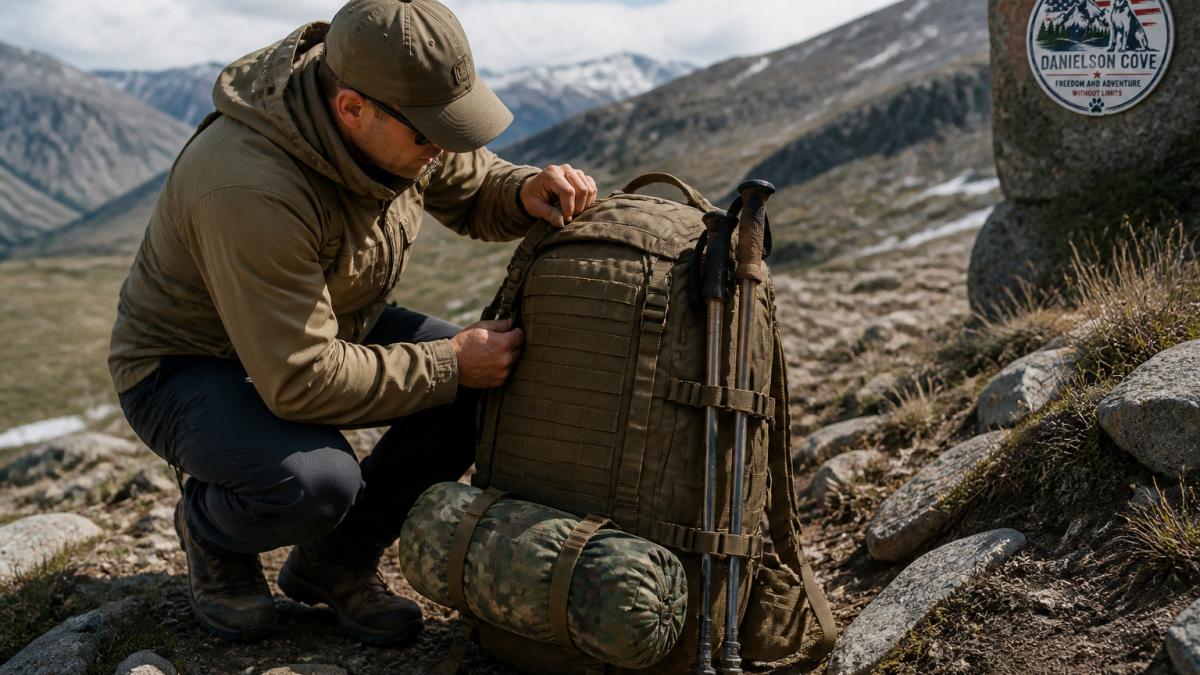
!A hiker on a mountain trail adjusting a loaded tactical backpack, with a folded trekking pole and a camouflage waterproof bag strapped to the pack
For a lighter option, our Lightweight Camouflage Waterproof Bag keeps gear dry without adding much bulk.

The article's key pack-fit and weight measures are summarized below.
| Measure | Value | Note |
|---|---|---|
| Torso length range | 16 to 22 inches | Maps to small, medium, large frames |
| Torso length measured from | C7 vertebra to hip bone top | Not height |
| Tactical pack fabric | 1000D Cordura | Durable but adds weight |
| Compromise pack fabric | 500D | Keeps durability, sheds weight |
| Base weight excludes | Food, water, fuel | Carried weight minus consumables |
Military Tactical Clothing: Layering for Changing Weather
Backcountry weather changes fast, and layering handles that better than one heavy jacket. Start with a base layer that wicks moisture, add insulation when temperatures drop, and finish with a shell for rain and wind.
Our Field Jacket With Liner - Woodland Camo suits this approach. The outer shell is ripstop nylon with a water-resistant coating, and the removable liner lets you adjust warmth. Machine wash cold, wash the shell and liner separately before first wear, and tumble dry low.

Keep the shell separate from the liner for cleaning. Mixing them can cause color transfer, which is an easy problem to avoid.
Military Survival Gear: Emergency Kits, Power and Navigation
Survival gear is insurance you hope never to use. The essentials are navigation, fire, light, and power for communication.
14-in-1 Outdoor Emergency Survival Kit →
Our 14-in-1 Outdoor Emergency Survival Kit packs a compass, whistle, wire saw, multi-tool card, folding knife, emergency thermal blankets, fire starter, and a carrying case into one kit. The tactical flashlight requires one AA battery, which is not included.

For keeping devices charged, the Portable Outdoor Power Bank offers USB-C and micro-USB ports and charges two devices at once. The Folding Sighting Compass with Inclination Scale includes a sighting window, a 360-degree dial, and a bubble level, at $246.49 for the single-compass option.
Shelter, Water and Trekking Support for Multi-Day Trips
Multi-day trips demand support for your body and your gear.
The Carbon Fiber Trekking Pole is available in 110 cm, 120 cm, and 130 cm lengths. Choose your length before ordering, and remember that each purchase includes one pole, not a pair.
For storing sleeping gear, the Sleeping Bag Compression Storage Sack comes in five sizes, from XS at 4 to 6 liters up to XL at 20 to 35 liters. It is made from 40D Silnylon Ripstop fabric. The sack holds the sleeping bag. Other contents are not included.
Tactical Camping Checklist: What to Pack by Trip Length
A checklist keeps you from overpacking for a weekend and underpacking for a week. The version below is organized by priority, essential, optional, and specialized, so you can scale it to trip length, season, and terrain instead of carrying everything every time. Weigh each category once, write the number on the list, and the checklist becomes a packing plan rather than a reminder.
Essential: never leave without these
- Navigation: a baseplate map and a sighting compass (see the Folding Sighting Compass), plus a backup on your phone
- Light and power: a headlamp, spare batteries, and a charged power bank
- Shelter: sleeping bag in a compression sack, sleeping pad, and a shelter rated for your expected weather
- Clothing: moisture-wicking base layer, insulation, and a waterproof shell
- Water: filter or chemical treatment, plus at least two liters of storage
- Emergency: survival kit, thermal blankets, whistle, and a fire starter in a waterproof container
- Medical: a first aid kit and a quick-release tourniquet strap for serious bleeding
- Food and fuel: stove, fuel, and one extra day of food beyond your plan
Optional: add when the trip earns it
- Trekking pole for steep or loaded descents
- Camp organizer hooks for cookware and small accessories
- Second layer set for trips over three days
- Extra battery capacity or a small solar panel for trips over five days
- Repair kit: duct tape, cordage, and a multi-tool
Specialized: match the trip, not the catalog
- [ ]
- Desert: extra water storage, sun protection, and a wide-brim hat
- Wet coastal or river terrain: dry bags for sleep system and electronics, plus a pack liner
- Dog trips: dog harness with MOLLE webbing, dog first aid, and a collapsible bowl
Scaling by trip length
For a weekend, the essential list plus one optional item covers most needs. For trips longer than three days, add a second layer set, extra fuel or battery capacity, and a trekking pole, and re-weigh the pack.
The Camping Organizer Hooks for 18-20 mm Rods, 5-Pack at $11.94 help keep cookware and small accessories organized at camp. They are for camp organization only and are not rated to support vehicle cargo or people.
Watch out: a checklist that never gets weighed is just a wish list, pack the bag, step on a scale, and cut the heaviest item you did not use on the last trip.
Putting Your Backcountry Kit Together With Danielson Cove
Build your kit around the trip, not the catalog. Start with navigation and emergency gear, add clothing that handles your local conditions, then choose a pack and support gear that fits your load.
Our Outdoor Double Magazine Holster and Lightweight Camouflage Waterproof Bag, along with the survival and layering pieces above, are available for backcountry camping.
Danielson Cove donates 15% of profits to Daisy's Dane Sanctuary, a Great Dane rescue near Kansas City, Missouri.
Frequently Asked Questions
What tactical gear is useful for backcountry camping?
The most useful pieces cover four jobs: carrying the load, staying dry and warm, navigating, and handling emergencies. A pack with a comfortable frame, a layered jacket with a removable liner, a compass, a power bank for phones and GPS devices, and a waterproof bag for electronics and sleeping gear cover most trips. A compression sack for your sleeping bag saves pack space. Start with these basics and add specialty items only once you know where your trips take you.
Is tactical gear good for hiking and backpacking?
It can be, when the build suits the trip. Tactical gear is typically made from heavy-duty nylon, reinforced stitching and durable hardware, which tolerates brush, abrasion and rough handling well. The trade-off is weight. Heavier materials add pounds to your pack, so compare each item's weight against its durability before deciding. For short, rugged trips, durability often matters more. For long days with heavy loads, lighter options may serve you better.
What should I pack for an overnight backcountry camping trip?
Pack for the weather, not just the calendar. Bring a layered clothing system with a waterproof outer shell, a sleeping bag in a compression sack to save space, a waterproof bag to keep gear dry, a compass for navigation, a power bank, and a basic emergency kit with a whistle, fire starter and thermal blankets. A trekking pole helps on uneven ground. Carry enough water for the route and plan a treatment method for refills.
How do I choose a tactical backpack for hiking?
Start with capacity for your trip length and check how the pack carries weight. Look for a frame or hip support that keeps load off your shoulders, adjustable straps, and enough attachment points for gear you use often. Check materials and stitching, since they determine how the pack handles abrasion. Load the pack at home and walk with it before any trip. A pack that feels fine empty can become uncomfortable at full weight.
