


Rugged Dog Collar for Service: 3 Top Picks for 2026
Table of Contents
- Rugged Dog Collar for Service: What Actually Matters
- Quick Comparison: 3 Rugged Options for Working Dogs
- 1. Nylon Tactical Dog Collar: Best Everyday Service Collar
- 2. Ihrtrade Tactical Dog Harness: Best for Load-Bearing Tasks
- 3. Military Tactical Dog Harness: Best for Large-Breed Service Dogs
- Dog Collar Sizing Guide: Get the Fit Right the First Time
- Waterproof Dog Collar: What to Look For in Wet Conditions
- How to Clean a Nylon Dog Collar (and Keep Hardware Working)
- Frequently Asked Questions
Last Updated: October 8, 2026
Rugged Dog Collar for Service: What Actually Matters
A review of dog-worn equipment published in Frontiers in Veterinary Science reports that multiple studies document gait changes during leash walking with a collar. That finding matters more for a working dog than a pet: a service dog wearing the same collar eight hours a day needs gear that holds up without altering how it moves. At Danielson Cove, we build for that reality. This guide covers what separates a genuinely rugged dog collar for service from one that just looks the part, plus three picks for 2026.

Most collars are designed for a walk around the block. A service dog's collar is on during training, transit, public access work, and rest, which changes what you should demand from stitching, hardware, and fit.
Durability, Identification, and Comfort at a Glance
Three factors decide whether a collar survives working life:
- Durability: reinforced stitching, rust-resistant hardware, and fabric that does not soak up water and mud.
- Identification: clear service dog ID, whether that is an embroidered panel, a patch, or a tag that stays legible.
- Comfort: padded edges, correct width, and a fit that does not rub during long wear.
Get one wrong and the others suffer. A stiff collar that fits poorly causes chafing, and a chafed dog cannot work comfortably.
Quick Comparison: 3 Rugged Options for Working Dogs
All three picks come from our own line, and each suits a different job.
| Product | Price | Best For | Key Build Detail |
|---|---|---|---|
| Nylon Tactical Dog Collar | $23.62 | Everyday service wear | Military-grade nylon, rust-resistant hardware |
| Ihrtrade Tactical Dog Harness | $38.22 | Load-bearing tasks | Nylon vest with MOLLE system |
| Military Tactical Dog Harness | $51.57 | Large-breed service dogs | 1000D imitation nylon outer fabric |
1. Nylon Tactical Dog Collar: Best Everyday Service Collar
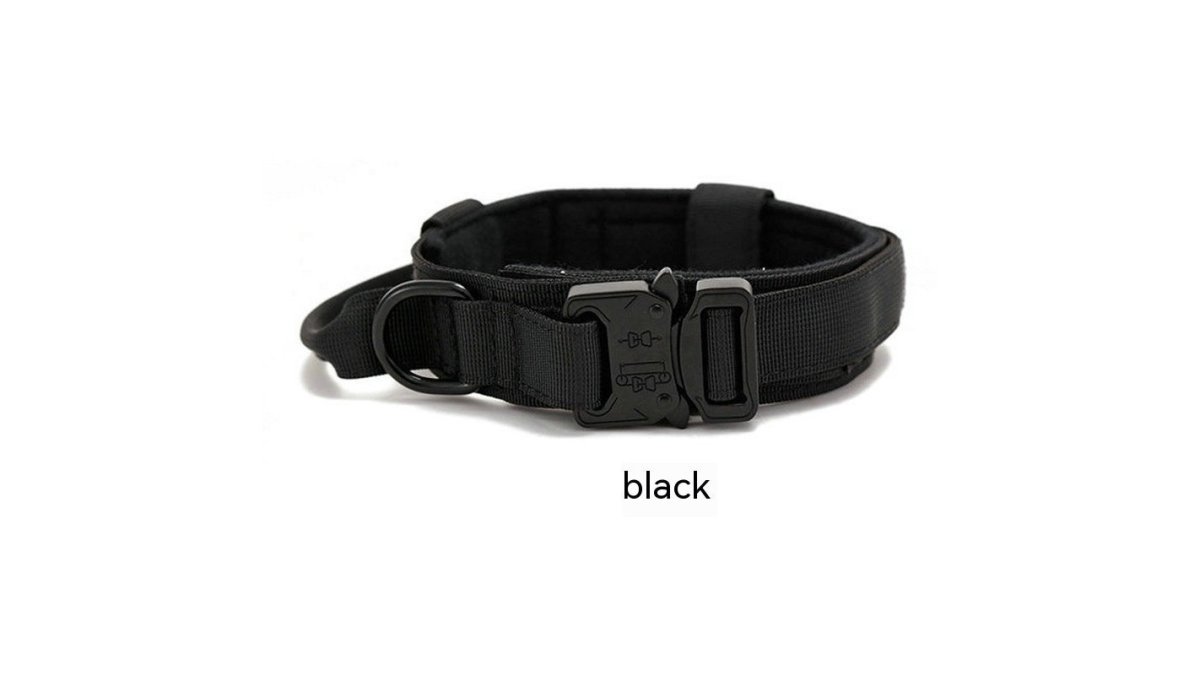
Our top pick for daily service work is the Nylon Tactical Dog Collar. It uses military-grade nylon with reinforced stitching and rust-resistant hardware, and the quick-dry fabric sheds water and mud instead of holding it, a detail most buyers underestimate, since a collar that stays wet against the neck irritates skin. It is machine washable on a gentle cycle, or hand wash with mild soap and air dry fully before storage. Sizes run M through XL, and it is manufactured in the USA.

2. Ihrtrade Tactical Dog Harness: Best for Load-Bearing Tasks
When the dog carries gear rather than just wearing identification, the Ihrtrade Tactical Dog Harness is the better tool. The nylon vest uses a MOLLE system for attaching pouches, and it comes in black, army green, mud, and CP.
3. Military Tactical Dog Harness: Best for Large-Breed Service Dogs
Large breeds need gear built to a different scale, and the Military Tactical Dog Harness is cut for that. The outer fabric is 1000D imitation nylon, a heavier weave than standard vest nylon, and the adjustable back fits a broad chest without pinching. For a German Shepherd or similar working breed, the wider body panel distributes pressure better than a narrow strap harness.

Dog Collar Sizing Guide: Get the Fit Right the First Time
Sizing is where most service-collar purchases go wrong, not because handlers are careless, but because neck measurement, collar width, and the dog's working tasks all interact.
Measure the neck, not the head
Use a soft tape measure, not a string or ruler. Wrap it around the base of the neck, where the collar actually rests during work, not at the widest point of the head or the shoulders. Keep the tape level, because an angled measurement reads long and produces a collar that slides.
The two-finger test, done properly
Slide two fingers flat under the collar at the side of the neck, not the front. The collar should move freely over the fingers without lifting away. Three fingers means it is loose enough to slip over the head during a head turn or correction; if two will not fit, it presses on the trachea during a long down-stay.
Size bands for the Nylon Tactical Dog Collar
- M: 16-20 inches
- L: 20-24 inches
- XL: 24-28 inches
Measure at the base of the neck, add the two-finger allowance, then match to the band.
Match collar width to the dog's tasks
Width is a variable that determines whether a collar is comfortable for long hours of work.
- Narrow collars (roughly 3/4 to 1 inch): fine for identification only. Light, low-profile, easy to tuck under a vest.
- Mid-width collars (roughly 1 to 1.5 inches): the practical default for a collar plus leash attachment during public access work, spreading leash pressure over a wider area.
- Wide collars (roughly 1.5 to 2 inches): useful for large breeds and dogs that pull into the collar during training, though the added weight is its own problem on a small dog.
A standard ID collar suffices for identification and light leash work. A wider, more rugged collar earns its place when the dog is leashed for long stretches, is large enough that a narrow collar concentrates pressure, or the collar is the primary attachment point for a working leash.
Fit checks after the first week
A new collar settles: nylon relaxes with body heat and use, and the coat compresses under the band.
When to remove the collar
Working dogs should not wear a collar 24 hours a day. Remove it for crate rest, overnight sleep, and any time the dog is unsupervised in a confined space where a tag or buckle could catch. A collar that is off during rest lasts longer and rubs less during work.
Waterproof Dog Collar: What to Look For in Wet Conditions
No collar repels water forever. What matters is whether the material dries fast, whether the hardware survives repeated exposure, and whether the stitching holds when wet.
Fabric: what actually repels water
Nylon is the practical default for working collars, but not all nylon behaves the same way.
- Standard woven nylon absorbs water into the weave, darkens, stays damp against the neck for hours, and takes a full day to dry in humid conditions.
- Coated or quick-dry nylon beads water at the surface, stays comfortable within minutes of a wet session, and does not hold odor the way uncoated nylon does.
- 1000D nylon resists abrasion better than lighter nylon but is stiffer and takes longer to break in at the contact points.
- Leather sheds surface water well but requires conditioning, stiffens when dry, and is a poor choice for a dog that swims or works in mud regularly.
For a service dog working in wet conditions, quick-dry nylon sheds water rather than absorbing it, so the collar is not sitting wet against the neck for hours.
Hardware: the failure point that matters most
A corroded D-ring is a failed connection point, and it fails silently. Look for hardware described as rust-resistant or coated, not just "metal."
- Stainless steel resists corrosion best and is the standard for saltwater exposure, but it is heavier.
- Coated or plated steel is lighter and cheaper, holding up well in fresh water and rain, but the coating can chip where the D-ring meets the leash clip.
- Uncoated carbon steel will rust and has no place on a working collar.
Stitching: the stress point nobody inspects
The stitching at the D-ring attachment point carries the full load of the leash, and on a wet collar it is the first place water pools and thread degrades. Look for reinforced stitching, multiple rows or a box-X pattern at the stress point rather than a single line.
What to check before you buy
- Fabric that beads water instead of darkening and staying damp
- Hardware described as rust-resistant
- Stitching that is reinforced at the stress points where the D-ring attaches
Drying and storage after a wet session
Shake the collar out, wipe the hardware with a dry cloth, and hang it to air dry fully before it goes back on the dog. Never store a damp collar, trapped moisture degrades stitching and speeds corrosion.
How to Clean a Nylon Dog Collar (and Keep Hardware Working)
Cleaning a nylon collar takes about five minutes and prevents most of the wear that shortens its life.
- Remove the collar.
- Machine wash on a gentle cycle, or hand wash with mild soap.
- Rinse thoroughly so no soap residue stays in the weave.
- Air dry completely before putting it back on the dog.
For working dogs, build this into a routine: clean after muddy or wet sessions and inspect hardware regularly.
Service work asks a lot of a dog, and the gear should not be the weak link. At Danielson Cove, we build rugged dog collar and harness options for handlers who need reliability in the field, from the quick-dry Nylon Tactical Dog Collar to load-bearing MOLLE harnesses for larger breeds. Every purchase also supports our commitment to donate 15% of profits to Daisy's Dane Sanctuary, a Great Dane rescue near Kansas City, because caring for working animals is the whole point of what we do. Add to cart and gear up for the next trip.
Frequently Asked Questions
What features should a service dog collar have?
A service dog collar needs four things: durable construction that holds up to daily work, secure hardware that will not rust or fail, a comfortable fit that does not rub during long shifts, and clear identification. Nylon with reinforced stitching and rust-resistant hardware covers the first three. For identification, many handlers pair the collar with a vest patch or ID card.
How should a working dog collar fit?
Measure your dog's neck with a soft tape measure, then allow one to two fingers of space between the collar and the neck. Too loose and the collar can slip off during a task; too tight and it causes chafing on long shifts. The Nylon Tactical Dog Collar comes in M (16 to 20 inches), L (20 to 24 inches), and XL (24 to 28 inches), so you can match the size to your dog's actual measurement rather than guessing.
Are waterproof dog collars suitable for hiking and wet conditions?
Yes, if the fabric and hardware are built for it. Quick-dry nylon sheds water and mud rather than absorbing it, which keeps the collar from staying damp against your dog's neck. Rust-resistant hardware matters just as much. After wet hikes, rinse the collar, air dry it completely, and inspect the hardware before your next outing.
How do you clean and maintain a rugged dog collar?
Machine wash the collar on a gentle cycle or hand wash it with mild soap, then air dry completely before storage. Do not put it in the dryer. Inspect the D-ring, buckle, and stitching every few weeks for signs of wear. A collar that gets rinsed after muddy outings and checked regularly will last longer than one that is only cleaned when it looks dirty.
Should a service dog wear identification on its collar?
Yes. Carrying visible identification on the collar or vest, such as an ID card or embroidered patch, can help staff understand the dog's role.