


Best Materials for Dog Gear That Withstand Saltwater
Last Updated: October 23, 2026
Quick Summary
The best materials for saltwater dog gear are polyester or coated webbing paired with 316 stainless steel or solid brass hardware. Polyester absorbs less water than nylon and dries faster, while marine-grade metals resist chloride pitting through repeated soak-and-dry cycles.
- Rinse saltwater dog gear in cool fresh water within a few hours, then air dry fully in shade.
- 304 stainless resists light spray but pits under repeated seawater exposure; 316 adds molybdenum for chloride resistance.
- Plated hardware only resists until its coating chips, then the base metal rusts quickly.
- Avoid mixing dissimilar metals in saltwater, which triggers galvanic corrosion on the less noble part.
- Hand wash with mild soap and cool water monthly during heavy beach season; never machine wash.
Table of Contents
- Why Saltwater Destroys Ordinary Dog Gear
- Saltwater Dog Gear Materials, Compared
- Dog Gear Hardware Corrosion Resistance Explained
- The Best Material for a Dog Leash Near the Ocean
- What Makes a Waterproof Dog Harness Actually Waterproof
- How to Clean Dog Gear After Saltwater Exposure
- Frequently Asked Questions
Why Saltwater Destroys Ordinary Dog Gear
Saltwater is a corrosion engine. Most "outdoor" dog gear was never built for that combination.
This guide breaks down the best materials for saltwater dog gear, material by material, so you can buy once instead of replacing rusted buckles every season.
Most guides treat "waterproof" as a yes-or-no label. In practice, saltwater damage is cumulative: gear that survives one beach day looks fine, but gear that survives fifty is built from different stuff entirely.
Saltwater Dog Gear Materials, Compared
Saltwater dog gear is only as good as its two weakest components: the webbing that takes the load and the hardware that connects it. A premium leash body paired with a plated snap hook is a rusted hook waiting to happen.
The table below summarizes how each material family performs under repeated saltwater exposure.
| Material | Saltwater Resistance | Main Trade-off | Best For |
|---|---|---|---|
| Polyester webbing | High | Slightly stiffer feel | Collars, leashes |
| Nylon webbing | Moderate | Absorbs water, slower dry | Harnesses, load-bearing |
| TPU/PVC-coated webbing | High | Coating can crack if kinked | Beach and boat use |
| Stainless steel hardware | High | Heavier, higher cost | Saltwater-first setups |
| Solid brass hardware | High | Develops patina | Collars, D-rings |
| Plated metal hardware | Low | Chips and rusts | Dry-climate use only |
Webbing: Nylon vs. Polyester vs. Coated Cores
Polyester webbing is the better base choice for saltwater because it absorbs less water than nylon and dries faster. Nylon is stronger and softer against skin, which is why it dominates harness construction, but it holds moisture longer. Many makers compromise with a polyester core fully encased in a TPU or PVC coating, which keeps water out of the weave entirely.

Hardware: Stainless Steel, Brass, and Coated Metal
Stainless steel is the benchmark for buckles and D-rings in marine environments, with solid brass a close second. Plated metals are the weak link: once the plating chips, the base metal underneath rusts fast. When comparing gear, hardware grade matters as much as fabric.
Dog Gear Hardware Corrosion Resistance Explained
Dog gear hardware corrosion resistance comes down to one question: what happens when the coating fails?
- 304 stainless contains roughly 18% chromium and 8% nickel. It resists rust in fresh water and light spray, but chloride ions from seawater attack its passive oxide layer, and repeated exposure leads to pitting, small dark craters that grow into weak points and eventually seize moving parts.
- 316 stainless (often called marine grade) adds molybdenum, roughly 2-3%, which stabilizes that oxide layer against chlorides. It costs more and is heavier, but it is the grade that holds up to repeated soak-and-dry cycles without pitting.
- Solid brass resists corrosion well and develops a dull patina rather than rust. It is softer than stainless, so it suits D-rings and collar hardware more than high-load snap hooks, and it can wear at pivot points over years of use.
- Plated metals, zinc-plated steel, nickel-plated zinc alloy, are the weak link. The plating is a barrier, not a material property. Once it chips at a contact point or wears through at a pivot, the base metal underneath corrodes quickly, and a spring-loaded snap hook can seize from the inside.
There is a second failure mode most buyers never hear about: galvanic corrosion. When two dissimilar metals touch in saltwater, the less noble metal corrodes faster than it would alone.
How do you tell what you own? A magnet is a rough first test: 304 and 316 stainless are effectively non-magnetic, so a strong pull suggests plated steel or a low-grade alloy.
For saltwater-first setups, the rule is simple: specify 316 stainless or solid brass at every load-bearing connection, keep plated hardware off the beach entirely, and avoid mixing a plated part into an otherwise marine-grade rig. Our hardware is chosen with that hierarchy in mind.
The Best Material for a Dog Leash Near the Ocean
The best material for a dog leash near the ocean is marine-grade rope or polyester webbing paired with stainless steel hardware. Rope leashes shed water and sand rather than trapping them, and they don't develop the stiff, salt-crusted feel flat webbing can after repeated soakings.

Our Two-in-one double traction rope is built on reinforced nylon and marine-grade rope, with a dual-handle design that gives you independent control on wet rocks and crowded shorelines. For evening walks when visibility drops, the High Elasticity Glow-in-the-Dark Dog Leash uses nylon webbing with an elastic core that absorbs sudden pulls, plus a glow coating that keeps your dog visible after sunset.
Rope and coated webbing both last longer when you flush salt out after every coastal outing.
What Makes a Waterproof Dog Harness Actually Waterproof
A waterproof dog harness stays waterproof when three things are true: the outer shell sheds water, the padding doesn't sponge it up, and the hardware won't corrode. Miss any one and the harness is merely water-resistant, it tolerates a splash but soaks through under sustained exposure. Construction details decide which category a harness lands in: sealed or taped seams stop water from wicking through stitch lines, closed-cell padding resists saturation where open-cell foam holds water for hours, and coated webbing keeps the core dry. A tightly woven nylon or polyester shell with a durable water repellent finish handles spray and light rain, but it needs those supporting details to survive a swim.
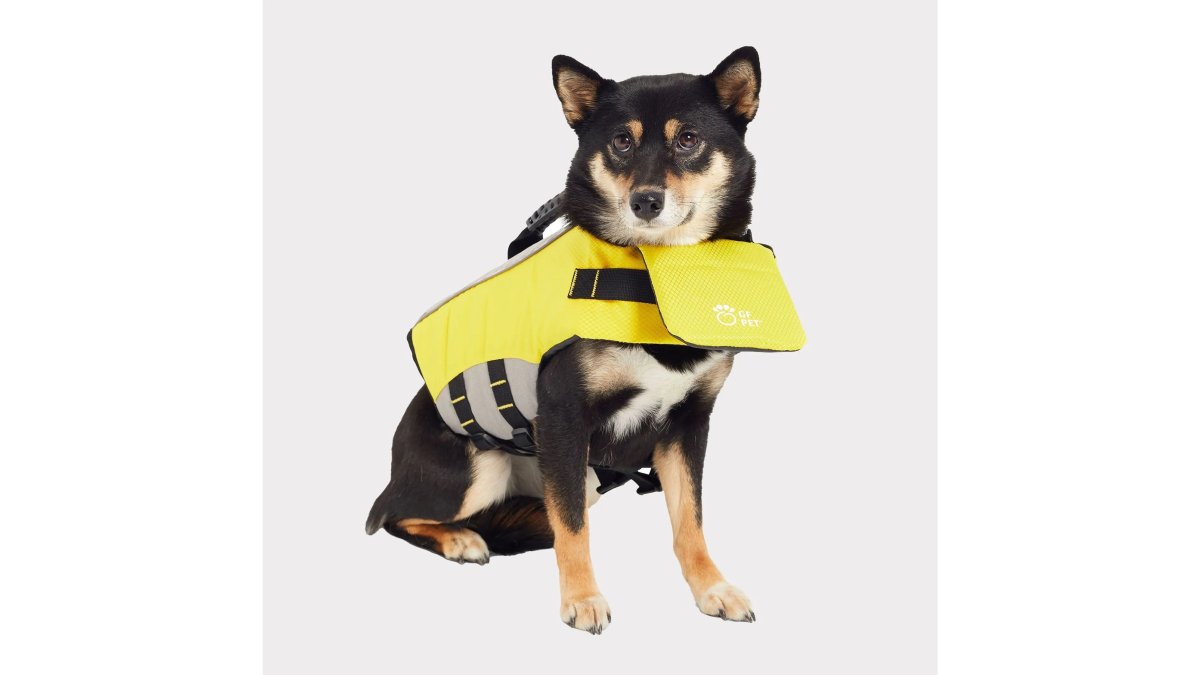
For dogs that spend real time in the water, a life vest adds buoyancy and visibility. Our Pet Life Vest uses water-resistant material with a quick-dry lining and reflective trim, with adjustable straps for a secure fit measured at the widest point of the chest.

How to Clean Dog Gear After Saltwater Exposure
Rinse dog gear in fresh water within a few hours of saltwater exposure, then air dry it completely away from direct sun. That single habit does more for gear lifespan than any coating or hardware upgrade.
Salt residue is the enemy. As seawater evaporates, it leaves chloride crystals inside webbing and around hardware pivots, and those crystals both abrade fibers and hold moisture against metal. A thorough rinse dissolves the salt before it concentrates. Here's the routine we recommend:
- Rinse with cool fresh water. Flush webbing, seams, and every metal pivot point. A garden hose works; a bucket of tap water works too. Hold the gear under flow rather than dunking it in standing water, so dissolved salt is carried away instead of re-deposited.
- Work the hardware. Open and close snap hooks and buckles several times under running water so salt doesn't dry inside the mechanism. A drop of fresh water worked into a pivot is worth more than any lubricant applied later.
- Wash with mild soap if needed. Hand wash with cool water and mild soap, never bleach or a washing machine. A soft brush lifts sand and salt from weave without abrading the coating.
- Air dry fully. Hang gear in shade with hardware separated from fabric so air reaches every surface. Flat webbing typically dries in a few hours in dry, breezy conditions; padded harnesses and rope leashes can take considerably longer, and a harness that still feels cool or heavy at the padding is not dry.
- Inspect after drying. Check stitching, coating integrity, and hardware for pitting or stiffness before the next trip.
That last step is where most owners stop short, and where gear life is actually decided. After drying, run a structured inspection:
- Seams: look for loose or frayed thread, especially where webbing meets hardware. Stitch failure under load is the one defect you cannot fix at home.
- Coatings: flex the webbing. A healthy TPU or PVC coating stays bonded and slightly supple; cracking, peeling, or a chalky white bloom at fold points means water is reaching the core.
- Hardware: check for pitting, stiffness in pivots, and any discoloration at contact points between dissimilar metals. A snap hook that no longer springs freely is a replacement item, not a maintenance item.
- Odor and stiffness: persistent musty smell or a stiff, salt-crusted feel after drying signals salt or moisture trapped in the core, which means the rinse was incomplete.
Rinse after every saltwater exposure.
Our Dog Breathable Harness calls for hand washing with mild soap and cool water, full air drying, and regular checks on straps and buckles, exactly the protocol saltwater gear needs.
Frequently Asked Questions
What materials hold up best in saltwater for dog collars and leashes?
Polyester webbing with a TPU or PVC coating holds up best because the plastic shell keeps salt water out of the fibers. Pair it with stainless steel or solid brass hardware. Plain nylon webbing absorbs water, dries slowly, and can stiffen after repeated soakings, so it needs a coating or a thorough rinse after every beach trip to last more than a season.
Is nylon or coated webbing better for dog gear exposed to saltwater?
Coated webbing wins for saltwater use. The coating blocks water from reaching the webbing core, so salt crystals cannot build up inside the fibers and grind them apart. Uncoated nylon is strong and affordable, but it soaks up seawater and takes hours to dry. If you already own nylon gear, rinse it in fresh water and air dry it fully after each trip to slow the breakdown.
Does saltwater damage stainless steel dog-gear hardware?
Stainless steel resists saltwater corrosion far better than plated metals, which can flake and rust once the plating chips. It is not indestructible: standing salt residue left on the metal for weeks can still cause pitting. Rinsing hardware with fresh water after beach days and drying it before storage keeps D-rings, buckles, and snap hooks working smoothly for years.
How should I rinse and dry dog gear after a beach trip?
Rinse every piece in fresh water within a few hours of leaving the beach, working the water into webbing, seams, and around hardware. Hand wash with mild soap, skip bleach and machine washing, and air dry completely away from direct sun. Pay extra attention to buckles and D-rings, where salt residue collects in crevices and starts corrosion.
What should I look for in a saltwater-resistant dog harness?
Look for coated or marine-grade webbing, stainless steel or brass hardware, welded D-rings, and reinforced stitching at stress points. Breathable mesh helps in heat but absorbs water, so rinse it well. The Danielson Cove Tactical Dog Harness Molle System Vest at $38.99 uses heavy-duty nylon with reinforced stitching and reflective accents for water crossings and rough terrain.
Can saltwater irritate a dog's skin under a harness or collar?
Yes. Salt residue trapped against the skin under a wet harness can cause itching and redness, especially on dogs with sensitive skin. Rinse the gear and your dog's coat with fresh water after swimming, and let the harness dry fully before the next wear. A proper fit with room to breathe, checked at the chest girth, also reduces rubbing on damp fur.
