


Portable Power Stations for Camping: 2026 Buying Guide
Table of Contents
- How to Choose the Right Portable Power Stations for Camping
- Camping Power Station Capacity Guide: Sizing Watt-Hours to Your Trip
- Portable Power Station for a Camping Fridge: What It Really Takes
- How Long Does a Portable Power Station Last?
- Portable Power Station Charging Options: Wall, Car, and Solar
- Cold Weather, Transport, and Campsite Etiquette
- What to Skip: Bad Advice and Hidden Costs
- Frequently Asked Questions
Last Updated: October 6, 2026
How to Choose the Right Portable Power Stations for Camping
Shopping for portable power stations for camping gets easier once you stop reading marketing copy and start reading four numbers. This guide covers the specs that decide whether a unit works on a trip, how to size capacity to your camping style, and where buyers waste money.
A portable power station is a rechargeable battery pack with an inverter that converts stored DC power into household AC current, letting you run laptops, lights, and small appliances away from an outlet.
The Four Specs That Actually Decide It
Ignore the peak wattage headline. Four specs determine real-world performance:
- Usable capacity (watt-hours): Total energy stored. Manufacturers sometimes quote a larger number than you can actually draw.
- Continuous output (watts): What the inverter sustains indefinitely. This is the number your devices must fit under.
- Surge power: A brief spike allowance for motors and compressors at startup.
The U.S. Department of Energy's energy storage basics explains why battery chemistry affects both weight and cycle life. Lithium iron phosphate (LiFePO4) cells generally last through more charge cycles than older lithium-ion designs, though they cost more upfront.
Camping Power Station Capacity Guide: Sizing Watt-Hours to Your Trip
Sizing starts with a simple formula: watts × hours = watt-hours. A 60-watt cooler running 10 hours needs roughly 600 watt-hours, plus a buffer for inverter losses.
Scenario Sizing: Weekend, Multi-Day, and Basecamp
| Trip Type | Typical Daily Need | Suggested Capacity | Notes |
|---|---|---|---|
| Overnight car camping | 200-400 Wh | 300-500 Wh | Phones, lantern, small fan |
| Weekend trip | 500-900 Wh | 700-1,000 Wh | Adds a cooler and camera gear |
| Multi-day basecamp | 1,000-1,800 Wh | 1,000-2,000 Wh | Fridge, laptop, dog GPS tracker |
| Extended off-grid stay | 2,000+ Wh | 2,000 Wh+ with solar | Pair with panels for daily refill |
For a deeper look at how storage systems are rated and tested, the National Renewable Energy Laboratory's battery research publishes plain-language material on capacity and degradation.
Portable Power Station for a Camping Fridge: What It Really Takes
A portable power station for a camping fridge needs to cover the compressor's startup surge plus a full day of cycling.
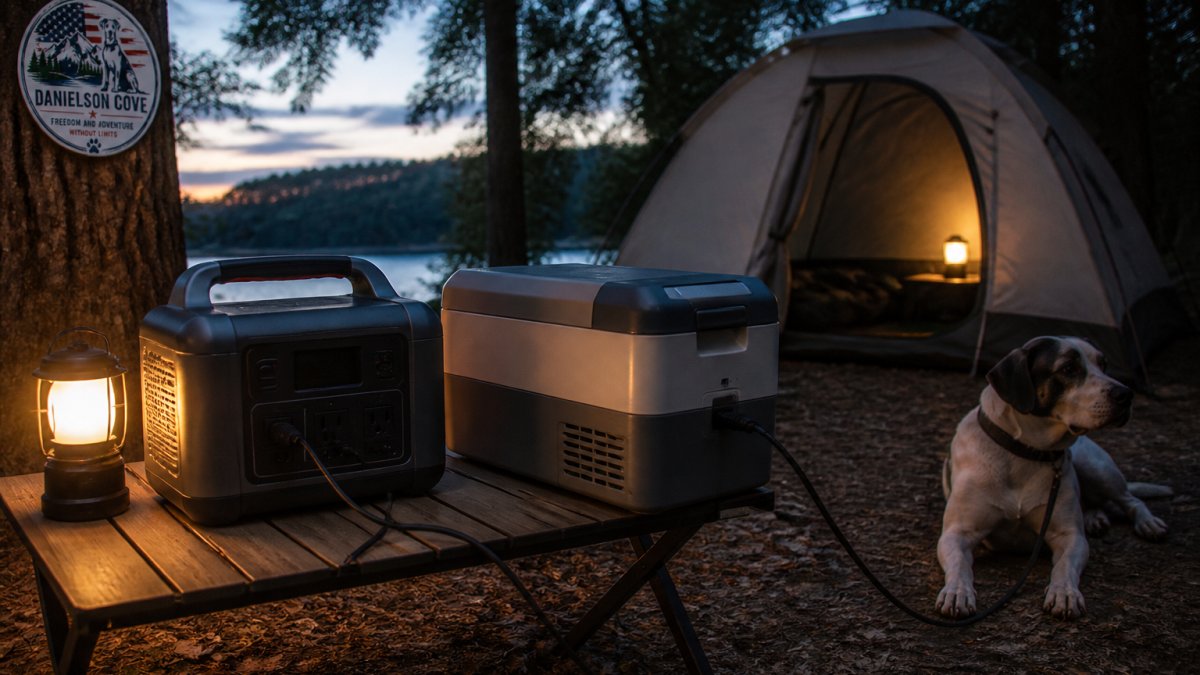
Two habits stretch that budget: pre-chill the fridge at home on wall power, and shade the cooler so the compressor runs less. A unit with pass-through charging lets you top up from solar while the fridge stays plugged in.
How Long Does a Portable Power Station Last?
A portable power station lasts two different lengths of time, and confusing them leads to bad purchases. Runtime per charge is how long one full battery gets you. Battery cycle life is how many full charges the cells survive before capacity drops noticeably.
Runtime Per Charge vs. Battery Cycle Life
Runtime depends entirely on load. A 1,000-watt-hour station running a 100-watt load lasts around 10 hours in theory, less in practice once inverter losses are counted. Halve the load and you roughly double the runtime.
Cycle life is a manufacturing spec. LiFePO4 packs commonly carry ratings in the thousands of cycles, while older lithium-ion packs are rated lower. Storing a unit at full charge in a hot garage shortens that life faster than any camping trip will.
Portable Power Station Charging Options: Wall, Car, and Solar
Three charging paths matter, and the best camping setups plan for all of them before the trip starts. What separates a station that keeps running from one that dies on day two is not the number of ports, it is how each path performs under real conditions, and how you sequence them.
Wall charging: your fastest refill, and the one you should not skip
Wall charging is almost always the fastest method a station supports, and it is the one to use the night before you leave. A full charge at home means you start the trip at 100 percent instead of hunting for an outlet at a trailhead.
Two details decide how fast wall charging actually goes:
- Input wattage cap. A station will not charge faster than its own AC input limit, no matter what the outlet can supply. A 15-amp household circuit on a standard 120-volt outlet delivers far more than most camping stations accept, so the station's input rating is the bottleneck.
- Charge profile. Most lithium packs charge at full speed to roughly 80 percent, then taper to protect the cells. The last 20 percent can take as long as the first 80 on some units. If you are leaving in an hour, an 80 percent charge is usually the smarter target.
Car charging: slow, steady, and best treated as a top-up
Car charging runs through a 12-volt accessory socket or a DC input, and it is the slowest of the three paths on most units. It works well while you drive between campsites, but it will not rescue a depleted station in an afternoon.
A practical pattern: plug the station into the car at the start of every drive, unplug it when you stop.
Solar charging: the path that keeps a basecamp running
The math here is simple and unforgiving. Panel output in the field is almost never the panel's rated wattage.
Match panel wattage to the station's solar input limit, then add headroom for real-world losses:
| Situation | What to expect from a rated panel |
|---|---|
| Clear sky, panel angled at the sun, cool day | Closest to rated output |
| Clear sky, panel flat on the ground | Noticeably below rated output |
| Thin cloud or haze | A meaningful drop from rated output |
| Heavy overcast or shade | A small fraction of rated output |
A panel rated higher than the station's input cap wastes its extra capacity, the station will not accept more than its limit.
Before you trust any marketing language about solar input speeds, the Federal Trade Commission's guidance on solar claims is worth reading.
Sequencing the three paths on a real trip
A workable routine for a multi-day basecamp:
- Night before: full wall charge at home.
- Travel days: car charging whenever you are driving.
- At camp: solar panel out and angled by mid-morning, repositioned once or twice as the sun moves.
- Heavy-use days: fall back on wall charging if you pass a hookup or a friend's garage.
Where a small backup bank fits
Even a well-planned charging routine has gaps. A phone that dies at dusk, a dog tracker that needs a top-up mid-hike, a headlamp that runs out before the walk back, these are not jobs for a large station. That is the layer our Outdoor Emergency Charging power bank covers, with USB-C and micro-USB ports, dual-device charging, and a casing built for rough handling.

Cold Weather, Transport, and Campsite Etiquette
Most roundups stop at the spec sheet. The details below decide whether a station survives a season of trips.
How cold actually affects a lithium station
Lithium cells resist discharging when they are chilled. The chemistry slows down, internal resistance rises, and the usable capacity you can draw from a full pack drops.
Two rules matter more than any spec:
- Never charge a frozen battery. Charging below freezing can cause permanent damage to lithium cells. Let the station warm to room temperature first, overnight inside a tent or vehicle is usually enough.
- Insulate overnight, discharge during the day. A station kept off the cold ground and wrapped in a blanket or sleeping bag holds more usable capacity than one left exposed. Run your heaviest loads during the warmest part of the day.
Heat is the other end of the problem. Storing a unit at full charge in a hot garage or a closed vehicle in summer accelerates capacity loss faster than any camping trip will.
Transport: vehicles, straps, and the rules that apply
In a vehicle, the priority is containment. A station that slides forward during braking becomes a projectile. Strap it down, keep it low, and route cables so they cannot catch on a seat or a door.
Air travel has its own rules. Spare lithium batteries face restrictions in both carry-on and checked baggage, and the Federal Aviation Administration's battery safety rules lays out the limits and the labeling requirements.
Campsite etiquette that keeps you welcome
A power station is quiet, but the habits around it are not always. A few that experienced campers follow:
- Respect quiet hours. Fans, inverters, and warning beeps carry farther than you think at night. If a unit has a silent mode or a display-off setting, use it after dark.
- Keep cables out of walkways. A cable strung across a path is a trip hazard for people and a chew hazard for dogs. Route it along a tent wall or under a mat.
- Never leave a unit charging unattended in a tent. Heat has nowhere to go in a sealed tent, and a fault is far more dangerous in an enclosed space than in the open.
A note on dogs at camp
If you camp with a dog, the station's job description expands. A GPS collar tracker, a heated mat on a cold night, a fan on a hot afternoon, small loads individually, but they run for hours. Budget for them the same way you budget for your own devices, and keep pet-gear cables secured where a curious dog cannot reach them.
Cold, heat, transport, and campsite habits are not footnotes to the spec sheet, they are the difference between a station that lasts several seasons and one that fails on trip two. Plan for them the same way you plan for capacity.
What to Skip: Bad Advice and Hidden Costs
The most common mistake is buying capacity you will never use. A 2,000-watt-hour unit is dead weight on overnight trips, and you paid extra for it.
Hidden costs add up fast:
- Solar panels sold separately. Many bundles exclude them.
- Replacement cables and adapters. Proprietary connectors lock you in.
- Slower-than-advertised recharge. Real times often exceed the spec sheet.
A small, weather-resistant power bank belongs in every pack as a backup for phones and GPS units. Our Outdoor Emergency Charging power bank covers that layer with USB-C and micro-USB ports, dual-device charging, and a military-grade polymer casing built for rough handling.
Choosing the right station comes down to matching watt-hours to your actual trip, not to the biggest number on a box. Add the Outdoor Emergency Charging power bank to your kit and keep your devices running when the main station runs dry.
Frequently Asked Questions
How many watt-hours do I need for a camping power station?
Match watt-hours to what you actually run. Phones and headlamps need under 100Wh per day. A 12V cooler plus lights and device charging lands around 500 to 700Wh per day. Weekend trips with a fridge usually work with 500 to 1,000Wh, while multi-day basecamps with laptops and a larger cooler push past 1,000Wh. Add 20 to 30 percent headroom above your daily total so you are not draining the battery to zero every night.
Can a portable power station run a camping refrigerator?
Yes, if the continuous output and capacity line up. A typical 12V cooler draws 40 to 60W while the compressor runs, and compressors cycle on and off, so real draw is lower than the label suggests. You need a pure sine wave inverter with continuous output above the cooler's rating, plus enough watt-hours for overnight. Check the cooler's startup surge, because compressors briefly pull more power at startup than they do while running.
How do you recharge a portable power station while camping?
Three options cover most trips. Wall charging at home before you leave is fastest. Car charging through a 12V socket adds power on the drive out, though slowly. Solar panels are the only way to recharge off-grid, and real output depends on sun angle, cloud cover, and panel placement. Many stations support pass-through charging, which lets you run devices while the battery refills from a wall or solar source.
Is there a better brand than Jackery?
Brand matters less than specs. Compare usable capacity, continuous and surge output, recharge time, weight, and cycle life instead of brand name. The right pick depends on whether you prioritize portability, cold-weather performance, or total cost of ownership.