


Why Quality Stitching Matters for Dogs
Table of Contents
- Why Quality Stitching Matters for Dogs
- How Stitching Bears the Load: The Role of Stitching in Gear Durability
- Box-Stitching vs Bar-Tack Stitching for Dog Gear
- Safety Hazards of Weak Stitching and What Can Go Wrong
- How to Inspect Dog Collar Stitching for Wear and Tear
- Durable Tactical Dog Collars for Hiking: Material and Thread Selection
- Impact of Dog Movement and Environmental Stress on Stitching
- Quality Control Standards and What Manufacturers Check
- Frequently Asked Questions
Last Updated: September 27, 2026
Why Quality Stitching Matters for Dogs
When a tactical dog collar fails on the trail, it's rarely the leather or nylon webbing that gives way first. It's the stitching. This is where the entire load concentrates, every pull, every sudden movement, every anchor point where your dog's safety depends on thread holding under tension. At Danielson Cove, we understand why quality stitching matters for dogs: it determines whether your gear fails gracefully over months or catastrophically in seconds.

According to the American Pet Products Association 2026 State of the Industry Report, 95 million U.S. households owned at least one pet in 2025, with 53% of households owning at least one dog. That's a massive population of active dogs heading into wilderness areas, and their safety depends on equipment that won't fail. The pet industry reached $158 billion in spending in 2025 and is projected to hit $165 billion in 2026, yet most dog owners still don't understand what separates gear that lasts from gear that fails within weeks.
Most guides treat stitching as cosmetic, but it's structural integrity. It's the difference between a harness that holds under load and one that unravels when your dog lunges at a creek crossing.
How Stitching Bears the Load: The Role of Stitching in Gear Durability
Stitching distributes force across a harness or collar. When your dog pulls or lunges, the load concentrates at specific points: where the collar attaches to the leash ring, where the harness crosses the chest, where stress meets hardware. Those tension points are where stitching either holds or fails.
Research published in Reinvention: An International Journal of Undergraduate Research found that harness design significantly influences forelimb biomechanics, specifically shoulder and elbow flexion and extension in pet dogs. This means the stitching pattern you choose directly affects how force transfers through your dog's body during movement. Poor stitching forces your dog to compensate for uneven load distribution, leading to muscle fatigue and potential injury over time.
Stitching is the dynamic component that flexes with every micro-movement and tug. Over hundreds of thousands of micro-movements, stitching experiences cumulative stress that the base material never does. This is why stitching fails first.
Where Stress Concentrates in Dog Harnesses and Collars
Stress concentrates at attachment points: where the D-ring connects to the collar, where webbing overlaps at seams, where hardware anchors to fabric. A poorly stitched attachment point becomes a weak point that bears the full force of your dog's movement.
In tactical harnesses, the chest strap is the primary load-bearing component. A harness with single-row stitching will fail under sustained load, while reinforced multi-row stitching distributes force across multiple thread lines, dramatically increasing durability.
Why Stitching Fails Before the Material
Technical analysis from Slade Czech highlights that stitching is the component that typically bears the heaviest load and is the most common point of failure, often failing before the primary material itself. This seems counterintuitive until you understand the mechanics: thread has lower tensile strength than woven fabric. A single thread can hold maybe 5-10 pounds of tension before breaking. A row of 20 stitches running through webbing can hold 100+ pounds, but only if every stitch is intact and properly tensioned.
When one stitch fails, stress concentrates on remaining threads, accelerating failure. Within days, a single broken stitch can become complete seam failure.
Box-Stitching vs Bar-Tack Stitching for Dog Gear
Two stitching patterns dominate professional dog gear: box-stitching and bar-tack reinforcement. Understanding the difference is essential for choosing durable gear.
Box-Stitch Construction
Box-stitching creates a rectangular pattern around an attachment point, often with an X through the center. Force spreads across multiple thread directions, and if one section fails, the remaining three sides still hold.
A four-sided pattern means that even if 25% of the stitches fail, the attachment still holds. For hiking harnesses and tactical collars, this is the minimum acceptable standard.
Box-stitching requires precision; uneven tensioning creates weak points within the pattern itself.
Bar-Tack Reinforcement
Bar-tack stitching is a dense, perpendicular pattern that locks stitches in place and prevents unraveling. It's used at the highest-stress points: where a D-ring attaches to a collar, where a leash clip anchors to a harness.
Bar-tack stitching has higher tensile strength because the perpendicular pattern locks threads mechanically.
Safety Hazards of Weak Stitching and What Can Go Wrong
Weak stitching is a safety hazard. When a collar or harness fails on a trail, near water, or in unfamiliar terrain, your dog is unrestrained with consequences ranging from a lost dog to serious injury.
How to Inspect Dog Collar Stitching for Wear and Tear
Regular inspection catches problems before they become dangerous. Know what to look for and what each sign means.
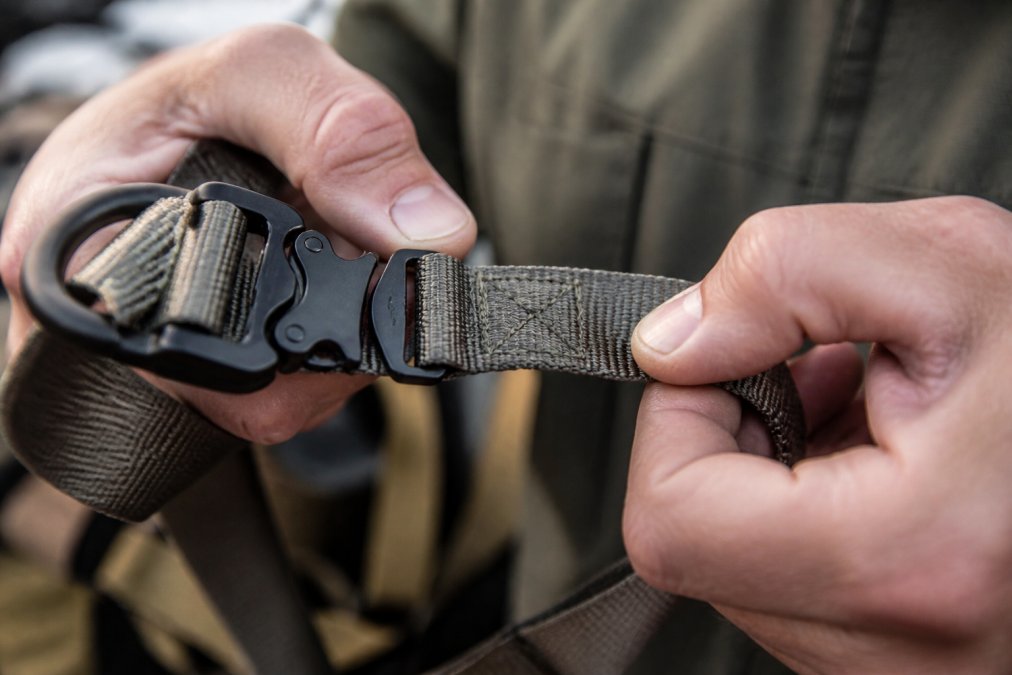
Visual Inspection Checklist
Look for these signs of stitching degradation:
- Stitch separation: Visible gaps between thread and material indicate the stitching is loosening.
- Thread discoloration: Faded or bleached thread suggests UV damage and reduced tensile strength.
- Unraveling: Thread pulling loose at seam edges means the seam is compromised.
- Stitch density changes: Stitches visibly farther apart than elsewhere indicate weak spots.
- Visible wear patterns: Areas showing more wear than surrounding sections are stress concentration points failing first.
Run your finger along every seam. Feel for a smooth, consistent line with no gaps or loose threads. If you can catch a thread with your fingernail, the seam is compromised.
Tension Testing and Hardware Check
Tension testing reveals hidden stress. Hold the collar or harness and apply steady, firm pressure at each attachment point, pulling the D-ring and webbing at seam locations.
Durable Tactical Dog Collars for Hiking: Material and Thread Selection
Collar durability depends on three factors: base material, thread, and stitching pattern. All three must work together. Understanding each component helps you choose gear that lasts.
Nylon Thread vs Polyester Thread
Nylon and polyester thread have different properties that affect longevity under load and environmental stress.

Military-Grade Nylon and Hardware Standards
Military-grade nylon webbing meets military specifications for tensile strength, abrasion resistance, and durability. It's typically thicker than commercial nylon, making it more durable under load.
Impact of Dog Movement and Environmental Stress on Stitching
Stitching fails because of repeated stress cycles, environmental exposure, and how your dog moves. Understanding these factors helps you predict when gear will fail.
Micro-Movements and Material Fatigue
Every time your dog moves, the gear shifts slightly. Over a day of hiking, your dog makes thousands of micro-movements, each creating a stress cycle on the stitching. After thousands of cycles, the thread fatigues and breaks.
UV Degradation and Weather Exposure
UV rays break down polymer chains in thread, reducing tensile strength over weeks and months. A harness left in the sun for a season will have noticeably weaker stitching than one stored indoors.
Quality Control Standards and What Manufacturers Check
The difference between gear that lasts and gear that fails often comes down to manufacturing quality control. Not all manufacturers inspect their products the same way, and this directly affects reliability.
A proper quality control process includes:
- Stitch inspection: Visual examination of every seam for density, consistency, and defects
- Pull testing: Applying a specific load to attachment points and measuring force at failure
- Hardware inspection: Checking for corrosion, proper welding, and secure attachment
- Material verification: Confirming that the webbing, thread, and hardware meet specified standards
| Inspection Point | What to Look For | What It Means |
|---|---|---|
| Stitch separation | Visible gaps between thread and material | Seam is failing and will unravel soon |
| Thread discoloration | Faded or bleached appearance | UV damage has reduced tensile strength |
| Stitch density | Gaps between individual stitches | Inconsistent manufacturing or weak spots |
| Hardware movement | Any shift or flex at attachment points | Connection is compromised and will fail |
| Unraveling edges | Thread pulling loose at seam ends | Seam integrity is already lost |
Frequently Asked Questions
What are the different types of stitching used in high-performance dog gear?
High-performance dog gear typically uses box-stitching and bar-tack reinforcement. Box-stitching creates a square pattern that distributes load across multiple thread lines, ideal for load-bearing attachment points. Bar-tack stitching adds concentrated reinforcement at stress points like buckle connections. Polyester and nylon threads are most common; polyester offers UV resistance while nylon provides tensile strength. Quality manufacturers combine these techniques to maximize durability and prevent stitch unraveling under the micro-movements and fatigue that occur during active outdoor use.
How can you tell if a dog collar or harness has high-quality stitching?
Inspect for even stitch density with no gaps or loose threads. High-quality seams should show reinforced stitching at tension points like buckle attachments and D-rings. Run your finger along seams, they should feel smooth and tight, not rough or separated. Check that stitching follows the webbing edge consistently without veering off. Test pull strength gently by tugging the seam; it shouldn't give or unravel. Look for box-stitch or bar-tack patterns at stress areas. Hardware should be rust-resistant and securely sewn, not loose or rattling. Signs of poor craftsmanship include uneven spacing, missing stitches, or fraying edges.
Why is box-stitching preferred for tactical dog collars?
Box-stitching distributes load across multiple parallel thread lines in a square pattern, creating redundancy at critical stress points. If one thread fails, others still hold the attachment together. This pattern is especially valuable for tactical collars used in hiking and backcountry trips where dynamic loads from pulling, jumping, and terrain changes create constant material fatigue. Bar-tack reinforcement often works alongside box-stitching to anchor the pattern at attachment points. The combination prevents catastrophic failure, a single seam rupture won't compromise the entire collar's integrity.
What are the risks of using dog gear with poor-quality stitching?
Poor stitching creates a safety hazard. Weak seams fail under load, causing collars or harnesses to separate during hikes, camping trips, or active play. Your dog could escape or be injured if gear fails on rough terrain. Stitch unraveling is often the first failure point, stitching typically fails before the base material itself. Inadequate thread density and low-quality materials increase fatigue resistance problems. Hardware attached with weak stitching can detach suddenly, leaving your dog without control or identification. On multi-week backcountry trips, gear failure is not just inconvenient, it's dangerous. Quality stitching with proper tension points and reinforcement prevents these failures.