Heavy Duty Dog Hiking Harness: 2026 Buyer's Guide
Table of Contents
- Why a Heavy Duty Dog Hiking Harness Matters on the Trail
- What to Look For in a Heavy Duty Dog Hiking Harness
- How to Measure Your Dog for a Hiking Harness
- Tactical Dog Harness for Hiking: When to Choose One
- Dog Hiking Safety Tips for Harness Users
- Maintenance and Cleaning for Trail Mud
- Conclusion
- Frequently Asked Questions
Last Updated: September 24, 2026
Why a Heavy Duty Dog Hiking Harness Matters on the Trail
A heavy duty dog hiking harness decides whether your dog finishes a long trail comfortably or spends the drive home licking raw skin. At Danielson Cove, we build and test gear on large breeds over rugged terrain, and most harness failures are slow: a strap that rubs a millimetre off course, a buckle that creeps loose on a descent, webbing that stretches after a season of mud and sun.
What to Look For in a Heavy Duty Dog Hiking Harness
The best heavy duty dog hiking harness combines load-bearing construction, secure hardware, and padding that distributes pressure across the chest rather than the throat.
| Feature | What Good Looks Like | Why It Matters |
|---|---|---|
| Webbing | High-tensile nylon, abrasion-resistant | Resists rock and brush wear |
| Stitching | Reinforced, bar-tacked at stress points | Prevents seam failure under load |
| Hardware | Rust-resistant metal or acetal buckles | Survives mud, rain, repeated washing |
| Padding | Padded chest plate, breathable mesh lining | Prevents chafing on long days |
| Adjustment | Multi-point adjustment at chest and belly | Keeps fit stable on varied builds |
Materials and Construction
Look for high-tensile nylon webbing with reinforced stitching at every load point. The chest and belly straps take the most force when a dog lunges or scrambles, so bar-tacked seams there are non-negotiable.
Hardware and Buckles
Buckle security is where budget harnesses fail first. Plastic side-release buckles crack in cold weather, and cheap metal snaps corrode after a few wet hikes. Quick-release buckles are convenient only if they lock positively and stay locked.
Padding and Pressure Distribution
Padding exists to spread load, not to look plush. A padded chest plate keeps the front strap off the trachea and spreads pull force across the sternum. Breathable mesh underneath reduces heat build-up on summer hikes.
How to Measure Your Dog for a Hiking Harness
To measure your dog for a hiking harness, take two measurements: girth (the widest part of the ribcage, just behind the front legs) and neck circumference at the base of the neck. Measure snug, not tight, and add room for a winter coat in cold weather.
Follow these steps:
- Stand your dog on a level surface with all four feet square.
- Run a soft tape around the deepest part of the chest, just behind the front legs. This is the girth measurement.
- Measure the neck at its base, where it meets the shoulders, not up near the ears.
- Measure from the front of the chest to the base of the ribcage for strap-length reference.
- Write the numbers down and re-measure once to catch errors.
- Compare against the manufacturer's size chart, sizing up if your dog sits between two sizes.
Tactical Dog Harness for Hiking: When to Choose One
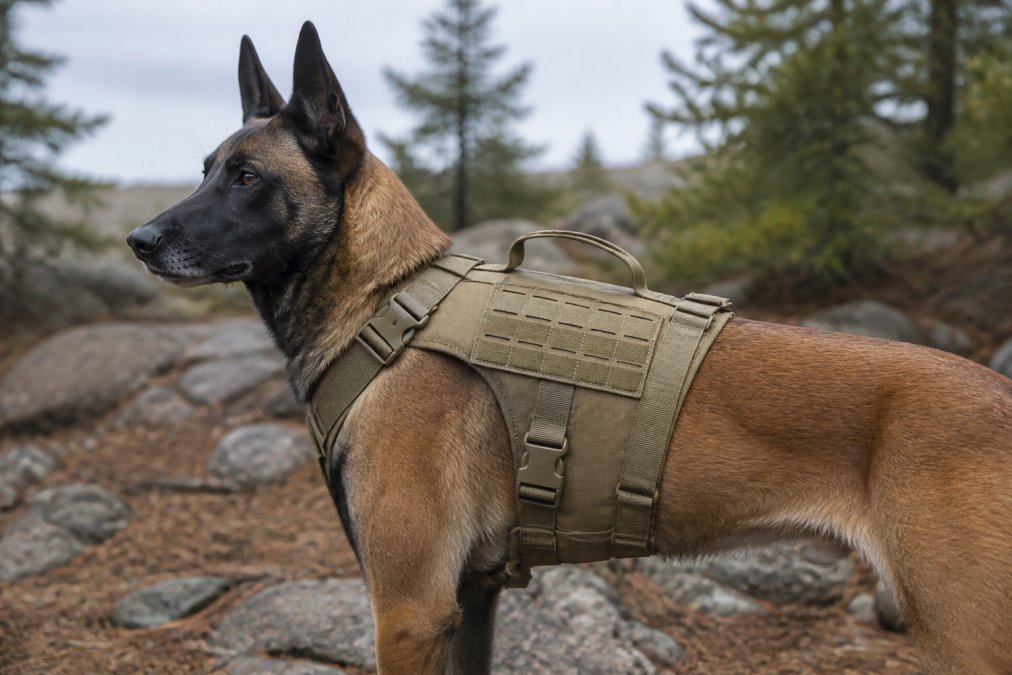
A tactical dog harness for hiking earns its place when you need load-bearing capacity, modular attachment points, or a structural handle for lifting your dog over obstacles. For a casual park loop, a lighter harness is fine. On technical terrain, the extra structure pays for itself, but only if you understand what it costs in weight, heat, and shoulder mobility.
- MOLLE webbing (Modular Lightweight Load-carrying Equipment) lets you attach pouches, a first-aid kit, a collapsible bowl, or a tracking unit directly to the harness instead of your own pack.
- A top grab handle gives you a control point on scrambles and a way to lift an injured dog without grabbing the chest strap.
- Reinforced, wider straps handle the extra load of a dog carrying their own supplies and resist distortion under a backpack.
- A load-rated back D-ring or V-ring positions leash pull over the strongest part of the back rather than the neck.
Layering a Harness Under a Dog Backpack
Most owners get this wrong the first time: they buy a harness and a backpack separately, then discover the pack's straps cross the harness's chest strap and create a rub point within an hour.
What works better:
- Choose a harness with a low-profile back panel. Thick padding under a pack saddle compresses and shifts.
- Route the pack's belly strap behind the harness's chest strap, not over it. Overlapping straps double the pressure on one spot.
- Check shoulder clearance with the pack loaded. A harness that clears the shoulder joint when empty can cross it once the pack sags.
- Test on a short weighted walk before a real hike. Ten minutes on flat ground reveals most rub points.
The Trade-Offs Nobody Mentions
Dog Hiking Safety Tips for Harness Users
Most harness safety advice stops at gear checks. The bigger risk on technical terrain is ergonomic: a harness that restricts shoulder movement changes how your dog climbs, showing up as fatigue, reluctance on descents, or soreness the next day.
How Harness Design Affects Shoulder Mobility
A dog's front leg drive comes from the shoulder, not the elbow. When a harness's front strap crosses the point of the shoulder, the bony prominence at the top of the front leg, it limits forward leg extension. On flat ground you may never notice; on a steep climb the dog compensates with the lower back and hindquarters, and that is where fatigue and strain accumulate.
What good ergonomic fit looks like:
- The front strap sits behind the shoulder point, not over it. You should be able to slide a finger between the strap and the shoulder joint when the leg is fully forward.
- The chest plate is narrow enough to allow the leg to swing. A wide plate covering the shoulder is a mobility limiter.
- The harness does not lift off the back when the dog pulls. If it does, load is transferring to the throat, not the chest.
Pre-Trip Gear Checks That Actually Matter
The harness is only as good as its weakest attachment point. Check these before every trip:
- D-ring and V-ring: look for deformation, corrosion, or a gap where the leash clip can slip out.
- Buckles: they should click shut with a firm snap and not release under a hard pull. Test each by hand.
- Stitching at stress points: bar-tacked seams at the chest and belly straps take the most force. Fraying there is a replacement signal, not a repair signal.
- Webbing at hardware contact points: fuzzy webbing near a buckle loses strength before it looks broken.
Trail Habits That Protect Your Dog
Beyond gear checks, these habits keep trail days safe:
- Use a fixed-length leash, not a retractable one. Retractable leashes give no reliable control on uneven ground and can wrap around legs on scrambles.
- Keep your dog's ID tag and a recent photo on your phone. Trailheads and junctions are where dogs go missing.
- Carry water and offer it every 20-30 minutes on warm days. A collapsible bowl on the harness's MOLLE panel makes this a one-handed stop.
- Watch the pads. Torn paw pads end trips early; check feet at every rest stop.
- Know the signs of overheating: heavy panting, thick drool, wobbling, or refusing to move. A top handle lets you carry a dog off the trail if they overheat.
- Yield to other trail users and keep the leash short around livestock and wildlife.
A harness gives you a control point at the chest and back, use both. On steep descents the back handle takes weight off your dog's joints; on scrambles it gives you a safe grip without pulling on the neck.
Maintenance and Cleaning for Trail Mud
Trail mud is the number one killer of harness longevity, and most owners clean it wrong. Mud that dries inside the webbing acts like sandpaper against the fibres, and residual grit wears the stitching from the inside out.
Clean your harness properly:
- Rinse with cool water at the trailhead or as soon as you get home, before mud dries.
- Soak in lukewarm water with a small amount of mild, non-detergent soap.
- Work a soft brush along the webbing to lift grit out of the weave.
- Rinse thoroughly until the water runs clear. Soap residue attracts dirt.
- Air-dry away from direct sun and heat. Never use a dryer or radiator.
- Check buckles and the D-ring for grit, then test every closure before the next trip.
For deeper maintenance, inspect monthly:
- Frayed or fuzzy webbing, especially where it contacts hardware
- Stitching that has pulled or loosened at stress points
- Buckles that no longer click shut with a firm snap
- Corrosion or stiffness in metal D-rings
- Padding that has flattened or separated from the shell
Conclusion
The gap between a harness that lasts a season and one that lasts years comes down to webbing quality, hardware, and maintenance. Get the fit right, check stress points before every trip, and clean mud off before it dries.
Frequently Asked Questions
What features should I look for in a heavy duty dog hiking harness?
Focus on abrasion-resistant nylon webbing, reinforced stitching, and metal hardware that won't rust. Look for a padded chest plate to distribute pressure. Breathable mesh lining helps prevent chafing on long hikes.
How do I measure my dog for a hiking harness?
Use a soft tape measure to find two key numbers: girth (the widest part of the ribcage, just behind the front legs) and neck circumference. Measure snugly but not tight. Write both numbers down and compare to the harness size chart. For dogs between sizes, size up for adjustability. Re-measure before buying a new harness, as weight changes can affect fit. A properly fitted harness should allow two fingers under the straps.
Can a heavy duty harness help with dogs that pull on the trail?
Yes. A harness can help manage pulling by distributing the load across the chest and shoulders. Pairing a harness with training yields the best results, especially for strong breeds.
Are tactical dog harnesses good for hiking?
Tactical dog harnesses work well for hiking when they fit properly and aren't overloaded. Their MOLLE system lets you attach small pouches for treats or a collapsible bowl, and the rugged construction handles brush and rocks. However, they can be heavier than standard hiking harnesses. For day hikes, a lighter padded harness may suffice. For multi-day trips or off-trail travel, a tactical harness with load-bearing capacity and a sturdy handle is a solid choice.
Choosing a heavy duty dog hiking harness is really a decision about how much you trust your gear when the trail gets rough. Danielson Cove makes that decision easier with military-grade nylon construction, reinforced stitching, rust-resistant hardware, and quick-dry fabric, all manufactured in the USA for dogs and owners who push past the easy miles. Get started with Danielson Cove and equip your next adventure with gear built to withstand the elements without limits.