Tactical Dog Harness vs Standard Harness: 2026 Guide
Table of Contents
- Tactical Dog Harness vs Standard Harness: The Core Differences
- Durability, Materials, and Hardware That Actually Hold Up
- MOLLE Webbing and Modularity: What You Gain
- Control, Handling, and Comfort for Large Dogs
- Tactical Harness vs Standard Harness for Hiking
- How to Fit a Tactical Dog Harness Correctly
- When a Tactical Harness Is Worth It (and When It Isn't)
- Frequently Asked Questions
Last Updated: September 30, 2026
Tactical Dog Harness vs Standard Harness: The Core Differences
A tactical dog harness is a heavy-duty system built from military-grade nylon, reinforced stitching, and rust-resistant metal hardware, designed to carry modular attachments and manage large, powerful dogs. A standard harness is lighter, simpler, and built for routine walks. The tactical dog harness vs standard harness question really comes down to one thing: how much control and durability your dog's daily life demands.

At Danielson Cove, we build gear for people who take their dogs into the backcountry, not just around the block. That shapes how we think about this comparison.
Forbes Vetted's 2026 harness testing identifies tactical harnesses as a primary category for large, powerful dogs that need hardware which resists bending and fraying. That's the functional core of the difference.
Build, Hardware, and Materials Compared
Standard harnesses typically use lightweight nylon webbing, plastic side-release buckles, and a single leash ring. They're affordable and easy to wash. They're also the first thing to fail when a 40-kilogram dog lunges.
Tactical builds swap plastic for metal where it matters: welded D-rings, load-bearing buckles, and webbing rated well beyond a casual walk. The trade-off is weight and cost.
| Feature | Standard Harness | Tactical Harness |
|---|---|---|
| Primary material | Lightweight nylon | Heavy-duty nylon, often military-grade |
| Hardware | Plastic buckles | Metal D-rings, quick-release buckles |
| Attachment system | Leash ring only | MOLLE webbing, multiple points |
| Handle | Rare or thin | Reinforced top grab handle |
| Weight | Lighter | Heavier |
| Best for | Calm dogs, short walks | Large breeds, rough terrain |
Weight and Bulk in Practice
Here's what most guides skip: tactical harnesses are heavier, and that weight is real.
A loaded tactical setup with pouches and patches adds noticeable grams across a long hike. For a fit, conditioned dog, that's negligible. For a senior dog or one recovering from injury, it's a genuine consideration.
a 2026 review of harness research found that wearing a harness of any kind can alter a dog's natural gait compared to walking without one. Fit matters more than category.
Durability, Materials, and Hardware That Actually Hold Up
Durability is where tactical gear earns its price. Industry testing for 2026 suggests that while tactical-grade materials aren't strictly necessary for every dog, a harness must have hardware that doesn't bend and straps that don't fray after minimal use to count as high quality (Forbes Vetted, 2026).
The failure points are predictable:
- Snap hooks that deform under sudden load
- Stitching that pulls at the stress points near the D-ring
- Webbing that fades and frays after repeated sun and mud exposure
Reinforced stitching at load points and rust-resistant hardware solve most of this. Quick-dry fabric matters too if your dog swims or works in wet conditions.
Our own Nylon Tactical Dog Collar uses military-grade nylon with reinforced stitching and rust-resistant hardware, and it's machine washable on a gentle cycle. This collar is built to withstand the elements without limits.
MOLLE Webbing and Modularity: What You Gain
MOLLE webbing is the row of horizontal nylon loops stitched across a tactical harness, letting you attach pouches, patches, and gear without buying a second harness. It's the single biggest functional gap between the two categories.
Standard harnesses don't have it. That's not a flaw; it's a design choice. A standard harness does one job.
Tactical modularity lets one system cover several: a treat pouch for training, a saddlebag for a day hike, a patch panel for identification. According to Rebarkable's tactical harness guide, this adaptability is driving the shift toward MOLLE-compatible gear as owners consolidate multiple harnesses into one.
Control, Handling, and Comfort for Large Dogs
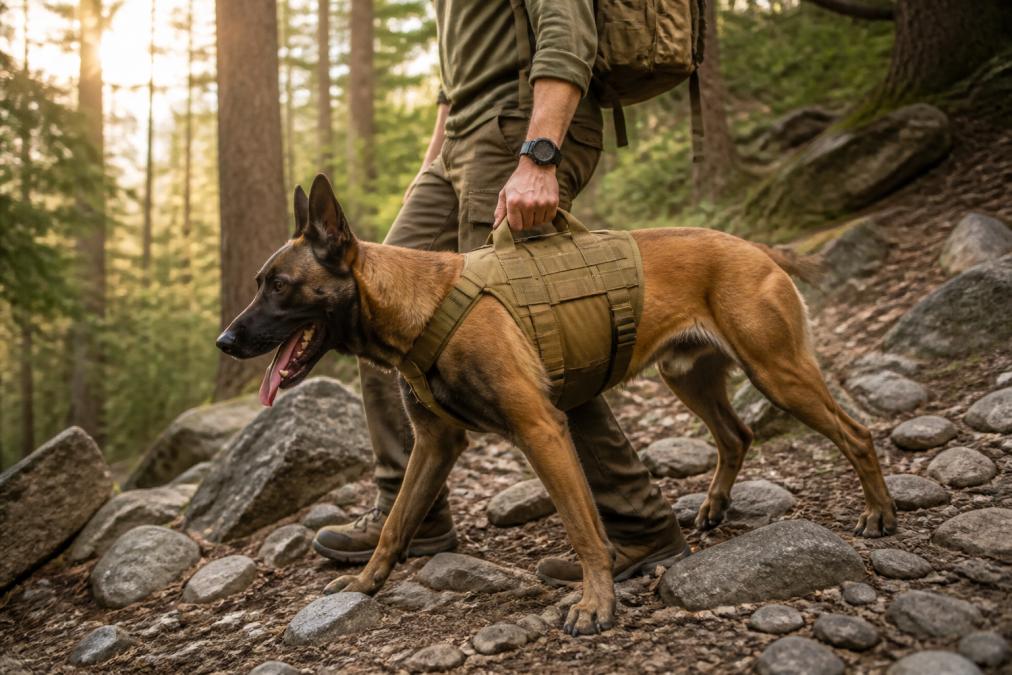
Control is the reason most owners start looking at tactical gear in the first place. A top grab handle lets you steady a dog instantly at a trailhead, lift them over a log, or hold them close in traffic. Standard harnesses rarely include one worth grabbing.
Tactical Harness vs Standard Harness for Hiking
For hiking, a tactical harness wins on control and gear carry; a standard harness wins on weight and simplicity. That's the short answer. The longer answer depends on terrain, dog size, trip length, and, the part almost no guide covers, how you're getting to the trailhead.
Where Each One Actually Wins on the Trail
Tactical wins when:
- You're on multi-hour climbs with a powerful or reactive dog and need a grab handle you can trust under load.
- You're carrying gear for the dog, water, a collapsible bowl, waste bags, a first-aid pouch, and want it on the harness rather than in your pack.
- You're crossing scree, roots, or slick rock where a sudden lift or steady is realistic.
- You want one system for hiking, training, and everyday walks.
Standard wins when:
- The hike is short, flat, and familiar.
- Your dog is small, senior, or recovering, and weight is the deciding factor.
- You want the simplest possible on-and-off for a dog who tolerates gear poorly.
- You're hiking in extreme heat and want the least material against the dog's body.
The Car-Safety Question Most Guides Skip
Here's a gap worth naming directly: neither a standard harness nor a tactical harness is automatically safe for vehicle travel. Harness category is not the same as crash-test certification.
What this means practically:
- For the drive to the trailhead, use a purpose-built, crash-tested car restraint or a secured crate, not your walking harness, regardless of category.
- For the hike itself, switch to the harness that fits the terrain and the dog.
- If you want one harness for both, look specifically for a harness that states it has been crash-tested, and confirm the testing standard. Tactical styling alone is not evidence of it.
A Simple Decision Framework
- Is the dog large, strong, and likely to need physical handling on the trail? If yes, tactical.
- Is the dog small, senior, or recovering? If yes, lean standard unless a specific tactical design is genuinely lightweight.
- Are you carrying gear for the dog? If yes, tactical's modularity earns its weight.
- Is the hike short and low-risk? If yes, standard is simpler and lighter.
- Are you driving to the trailhead? Regardless of answer above, use a crash-tested restraint for the drive.
the US Service Animal Registrar's harness guide notes that service dog harnesses are categorized by specific fit and material requirements to ensure mobility and effectiveness. The same logic applies to any working or adventure dog: fit and function first, category second.
How to Fit a Tactical Dog Harness Correctly
Fitting a tactical harness takes about five minutes and prevents most problems. Follow this sequence:
- Measure the widest part of the chest and the neck base with a soft tape.
- Match measurements to the size chart, not the breed label.
- Put the harness on and adjust the chest straps first, then the neck straps.
- Slide two fingers under every strap. If you can't, it's too tight.
- Check that the D-ring sits above the shoulder blades, not on the spine.
- Walk the dog, then re-check every strap for slack.
- Re-check fit monthly, and after any weight change.
When a Tactical Harness Is Worth It (and When It Isn't)
Tactical gear is worth it when your dog is large, strong, and goes where standard gear fails. It isn't worth it for every dog, and honest guides should say so.
Buy tactical if:
- Your dog is a large or giant breed with real pulling power
- You hike, camp, or train off paved ground
- You want one harness for multiple activities
- You need a reliable grab handle for control
Stay standard if:
- Your dog is calm and walks the same route daily
- Weight is a concern for a senior or recovering dog
- You want the simplest, lightest option available
The right harness is the one that fits your dog's body and your actual routine. Category is a starting filter, not the answer.
Frequently Asked Questions
Are tactical dog harnesses good for everyday walking?
They work well for daily walks if the fit is right. Tactical harnesses add weight and bulk compared to standard options, so a calm dog on short neighbourhood walks rarely needs one. For large, strong dogs that pull, hike, or train regularly, the padded chest plate and metal hardware distribute pressure better and hold up longer. The deciding factor is your dog's size, energy level, and how often you head out on rough terrain.
What is the most secure type of dog harness?
A well-fitted harness with multiple adjustable straps, metal D-rings, and quick-release buckles is the most secure. Research from the US Service Animal Registrar notes that fit and material quality matter more than the category itself. A tactical dog harness with a padded chest plate and reinforced stitching stays in place better on escape-prone dogs than a loose standard harness, but only if you tighten every strap and check the girth measurement before each walk.
Why do some dog trainers not recommend harnesses?
Some trainers worry that a harness encourages pulling because it removes pressure from the neck and lets a dog lean into the leash. A no-pull design with a front leash attachment point gives you steering control without choking, which addresses most of the concern trainers raise.
Is a tactical harness too heavy for a small dog?
Often, yes. Tactical harnesses are built for large, powerful breeds and use heavier webbing, metal hardware, and MOLLE panels. On a small dog that extra weight can change gait and cause chafing. Standard lightweight harnesses suit small dogs better. If you own a large breed and want breathable comfort on long hikes, a mesh option like the Dog Breathable Harness keeps airflow moving while still using heavy-duty webbing and reinforced stitching.