Military Grade Dog Harness: Choose Tactical Gear Right
Table of Contents
- What Makes a Military Grade Dog Harness Different
- Key Features of Tactical Dog Harnesses Worth Your Money
- How to Fit a Tactical Dog Harness for Maximum Comfort and Control
- Durable Tactical Dog Collars for Hiking and Backcountry Use
- Tactical Dog Gear Maintenance Tips for Long-Term Durability
- Breed-Specific Ergonomic Fit and Load-Bearing Capacity
- Why Comfort and Breathability Matter on Extended Trips
- Frequently Asked Questions
Last Updated: October 2, 2026
What Makes a Military Grade Dog Harness Different
A military grade dog harness is built with the same durability standards as gear designed for working K9 units, but engineered specifically for civilian adventure use. The key difference between true mil-spec equipment and tactical-style gear that merely looks military is in the materials, hardware, and construction methods. Real military-grade harnesses use materials that have been tested to withstand extreme conditions, not just marketed with tactical branding.
At Danielson Cove, we understand that active dog owners need gear that performs as hard as they do. The difference between a harness that holds up for weekend hikes and one that survives multi-week backcountry expeditions comes down to three things: material quality, hardware integrity, and stitching durability.
True Mil-Spec Materials vs. Tactical Aesthetics
The most common mistake outdoor enthusiasts make is confusing tactical appearance with tactical performance. A harness can have MOLLE panels and quick-release buckles but still fail under real load if the base fabric isn't engineered for it.
True mil-spec materials start with the fabric. Military-grade nylon, often called 1000D Nylon, is measured by its denier count, which indicates thread thickness and fabric density. Higher denier means greater abrasion resistance and tensile strength. This matters because a harness that shreds on rocky terrain or tears under branch snag becomes a liability, not a tool.
Research from the National Center for Biotechnology Information's review of harness design emphasizes that restraint equipment must be evaluated to ensure it does not compromise a dog's normal movement patterns. This is where many tactical-style harnesses fail, they prioritize rugged looks over biomechanical fit.
Tactical aesthetics, the MOLLE panels, the D-rings, the metal hardware, are valuable only when the foundation is solid. A poorly fitted harness with perfect hardware is still a poorly fitted harness. The webbing should be thick enough to distribute pressure evenly across your dog's body without creating pressure points during extended wear.
Hardware That Actually Holds Under Load
The hardware on a harness determines whether it stays together under stress. Military and police K9 units don't use plastic buckles or cheap metal snaps. They use hardware rated for hundreds of pounds of tensile strength because working dogs encounter unpredictable forces, jumping obstacles, pulling through brush, sudden directional changes.
Quick-release metal buckles serve two purposes: they hold reliably under load, and they allow fast emergency removal if needed. The material matters. Stainless steel resists rust in wet conditions. Mil-spec harnesses typically use either stainless hardware or anodized aluminum that won't corrode after exposure to rain, sweat, and mud.
D-ring attachment points should be backed by reinforced webbing patches underneath, this distributes the force across a larger area and prevents the attachment point from tearing through the fabric. Look for harnesses where hardware is backed by reinforced webbing patches underneath, this distributes the force across a larger area and prevents the attachment point from tearing through the fabric.
Key Features of Tactical Dog Harnesses Worth Your Money
Not every feature on a tactical harness justifies its cost. Some are genuinely useful for outdoor adventures. Others are marketing. Understanding the difference means you're not paying for gear you'll never use.
MOLLE System Compatibility and D-Ring Attachment Points
MOLLE (Modular Lightweight Load-carrying Equipment) is a system of webbing loops that allows you to attach additional gear using compatible patches or pouches. On a tactical dog harness, MOLLE compatibility means you can add water bottle carriers, treat pouches, or GPS trackers without modifying the harness itself.
This is genuinely useful if you're doing extended backcountry trips where your dog carries supplies. But for weekend hikes, MOLLE adds weight and bulk you don't need. The real value is in having multiple D-ring attachment points, usually 3-5 distributed across the harness, so you can clip a leash, attach a GPS unit, or secure a pack without compromising the harness structure.
D-rings should be positioned thoughtfully. A D-ring on the back is useful for attaching a pack. Side D-rings allow for leash attachment without twisting the harness. A front D-ring on the chest enables no-pull training control. Too many D-rings become snag points; too few limit functionality.
Quick-Release Metal Buckles and Reinforced Handles
Quick-release buckles serve a practical purpose: they let you remove the harness fast if your dog gets tangled or injured. But they also need to stay closed during active use. A good quick-release mechanism uses a two-stage action, you have to intentionally trigger it, not just bump it.
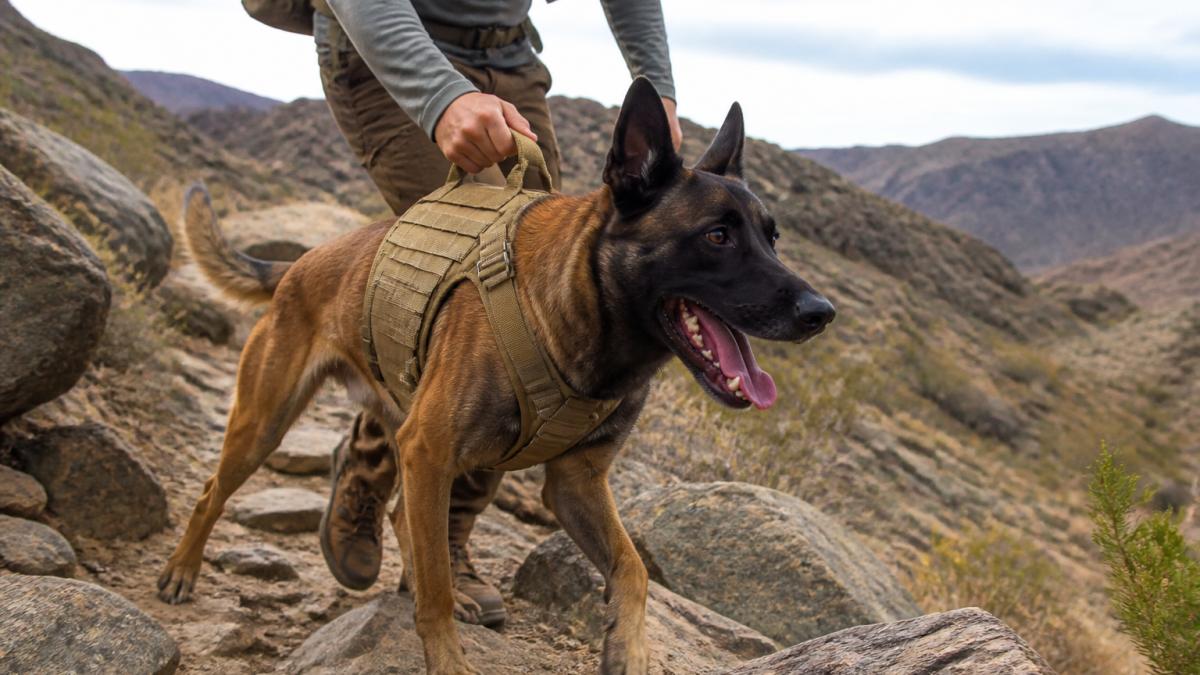
The reinforced handle on top of a tactical harness is one of the most underrated features. A sturdy handle lets you stabilize your dog on steep terrain, help them up a rocky slope, or steady them in fast water. The handle should be wide enough to grip comfortably and positioned so it doesn't interfere with the dog's shoulder movement.
Handles made from the same mil-spec webbing as the harness, with reinforced stitching underneath, will outlast handles made from thinner material or attached with standard thread. This is where quality construction becomes obvious, a handle that's just glued or loosely stitched will separate after a few hard uses.
How to Fit a Tactical Dog Harness for Maximum Comfort and Control
A harness that's too loose won't provide control. A harness that's too tight restricts breathing and causes chafing. The fit determines whether your dog is comfortable on a four-hour hike or miserable after an hour.
Measuring Your Dog and Adjusting Chest Straps
Start with an accurate measurement of your dog's chest. Use a soft measuring tape and measure around the widest part of the rib cage, just behind the front legs. Write this number down. Then measure your dog's neck to understand where the harness should sit at the shoulders.
Most tactical harnesses come in size ranges, Small, Medium, Large, XL, that correspond to chest measurements. A dog with a 22-inch chest typically fits Medium. But sizing varies by manufacturer, so always check the specific sizing chart for the harness you're considering.
The chest strap is the critical adjustment. It should sit snugly but allow two fingers of space between the strap and your dog's body. This gives enough room for movement without creating gaps where the harness can twist. Adjust all straps evenly. If one side is tighter than the other, the harness will pull sideways and cause discomfort.
Testing the Fit Before Your First Adventure
Before taking your dog on a long hike, wear the harness around your property for 30-45 minutes. Watch how your dog moves. Does the harness stay in place or does it shift? Are there any rub marks on the skin afterward? A properly fitted harness should leave no marks and should feel secure without being restrictive.
Check that your dog can move naturally, shoulders should have full range of motion, hind legs shouldn't be restricted. If your dog is limping or moving stiffly, the fit is wrong. Adjust and test again. A good fit takes 10 minutes of adjustment work.

Durable Tactical Dog Collars for Hiking and Backcountry Use
A tactical dog collar works alongside a harness to provide additional control points and ID attachment. Unlike decorative collars, a true tactical collar uses the same mil-spec materials as the harness, heavy-duty nylon webbing, reinforced stitching, and rust-resistant hardware.
Tactical Dog Gear Maintenance Tips for Long-Term Durability
A military-grade harness is built to last, but only if you maintain it properly. Mud, salt water, sweat, and UV exposure all degrade materials over time. Regular maintenance extends the life of your gear by years.
Cleaning Without Compromising Waterproofing
Most tactical harnesses use water-resistant treatments on the fabric, but these can be stripped by harsh cleaning methods. Hand wash your harness with mild soap and cool water. Avoid bleach, machine washing, and hot water, all of these damage mil-spec coatings.
Inspecting Hardware and Stitching Between Trips
After every significant use, inspect your harness for damage. Look at the stitching along stress points, where D-rings attach, where straps connect, around the handle. Loose threads should be trimmed.
Breed-Specific Ergonomic Fit and Load-Bearing Capacity
Large breed dogs, particularly Great Danes and other giant breeds, benefit from harnesses with reinforced handles and load-bearing capacity. A 150-pound Great Dane puts significant stress on harness attachment points. The hardware and stitching need to be rated for that weight.
Why Comfort and Breathability Matter on Extended Trips
A harness that causes discomfort after two hours of hiking will cause real problems on a full-day expedition. Breathability keeps your dog cool during exertion. Padding in the right places prevents chafing and pressure sores.
Frequently Asked Questions
What features define a true military grade dog harness?
A true military grade dog harness uses mil-spec materials like 1000D nylon webbing, rust-resistant hardware, and reinforced stitching designed to withstand extreme conditions. It includes quick-release metal buckles, D-ring attachment points, and a reinforced handle for control and lifting.
How do I know if a military grade dog harness will actually hold up on extended backcountry trips?
Check for mil-spec webbing, reinforced stitching details, and rust-resistant hardware in the product specifications. USA-manufactured harnesses often provide transparency about construction. Before a major trip, test the harness on shorter hikes to inspect for chafing, hardware wear, or stitching issues. Inspect all attachment points and buckles after each use to catch problems early.
How do I fit a tactical dog harness to prevent rubbing and chafing?
Measure your dog's chest and neck with a soft tape measure, allowing one to two fingers of space for comfort and safety. Adjust the chest strap so it sits snugly without pinching, and ensure the harness sits high on the shoulders without digging into the armpits. Check for rubbing after short walks before committing to longer trips. Breathable mesh padding and proper fit reduce friction that causes raw spots. Inspect your dog's skin after each use, especially around straps and attachment points.
What's the difference between metal and polymer hardware on tactical dog harnesses?
Metal hardware, particularly rust-resistant alloys, offers durability for heavy-duty use and long-term reliability in wet conditions. Polymer buckles are lighter and quieter. For backcountry trips and serious outdoor work, rust-resistant metal buckles and D-rings provide the durability and load-bearing capacity that mission-critical gear demands.